Hello, everyone, and welcome back to English Podcast with Alina, where every conversation helps you learn.
Hola a todos y bienvenidos de nuevo al Podcast de Inglés con Alina, donde cada conversación te ayuda a aprender.
I'm Alina.
Soy Alina.
Hello, Alina.
Hola, Alina.
Hello, everyone.
Hola a todos.
I'm Jake.
Soy Jake.
How are you today, Alina?
¿Cómo estás hoy, Alina?
I'm good, thank you.
Estoy bien, gracias.
But this morning was a little stressful.
Pero esta mañana fue un poco estresante.
My shower water was very cold.
El agua de mi ducha estaba muy fría.
I waited and waited, but no hot water.
Esperé y esperé, pero no había agua caliente.
Oh, no, that sounds terrible.
Oh, no, eso suena terrible.
Did you fix it?
¿Lo arreglaste?
Yes, I called my landlord and he helped me, but I had to explain the problem in English.
Sí, llamé a mi casero y me ayudó, pero tuve que explicar el problema en inglés.
And you, Jake?
¿Y tú, Jake?
I'm doing okay, but yesterday I had a problem too.
Me va bien, pero ayer también tuve un problema.
I ordered food online and they gave me the wrong order.
Pedí comida en línea y me dieron el pedido equivocado.
Oh, what did you do?
Oh, ¿qué hiciste?
I called the restaurant, but it was hard to explain the problem.
Llamé al restaurante, pero fue difícil explicar el problema.
I didn't know what to say.
No sabía qué decir.
I just said, this is wrong, many times.
Solo decía: esto está mal, muchas veces.
Well, that's actually our topic today.
Bueno, ese es precisamente nuestro tema de hoy.
Really?
¿En serio?
What are we talking about today?
¿De qué estamos hablando hoy?
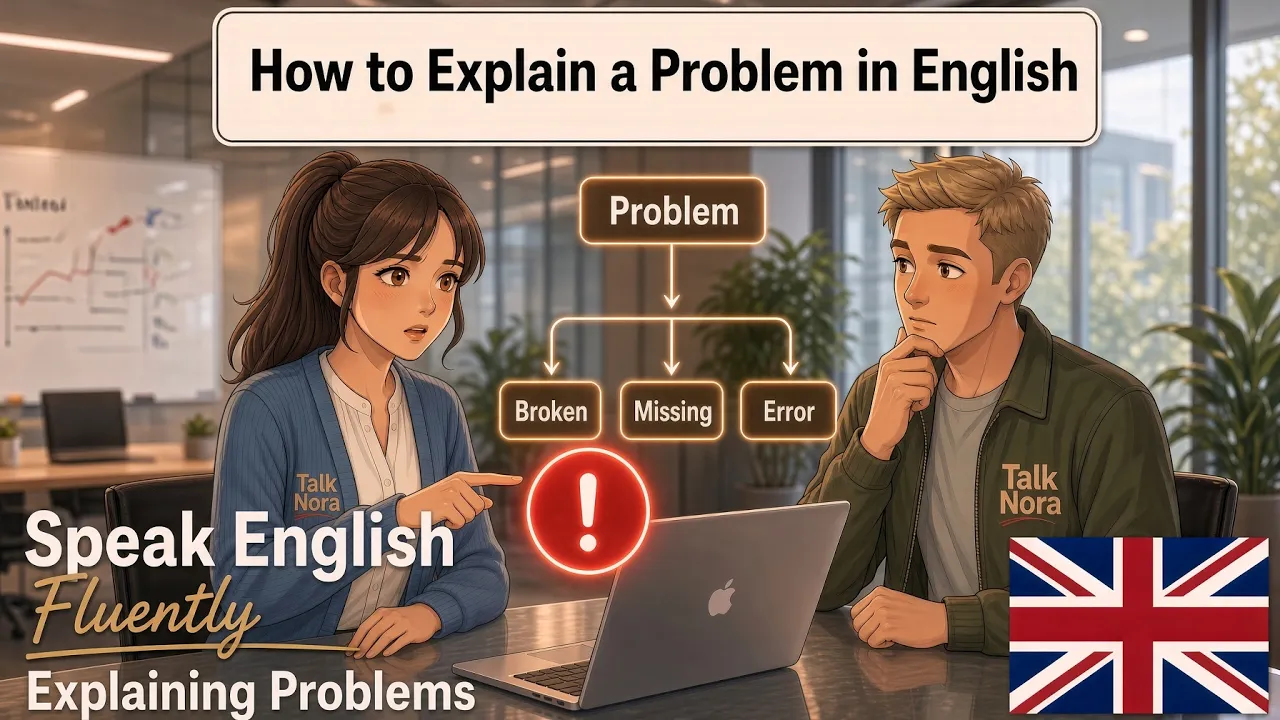
We're talking about how to explain a problem in English.
Estamos hablando sobre cómo explicar un problema en inglés.
When something is wrong, what do you say?
Cuando algo sale mal, ¿qué dices?
How do you ask for help?
¿Cómo pides ayuda?
And how do you respond when someone gives you advice?
¿Y cómo respondes cuando alguien te da consejos?
Ooh, I need this.
Uff, necesito esto.
Let's go.
Vamos allá.
But first, we have a small request.
Pero primero, tenemos una pequeña petición.
Yes.
Sí.
If you like our podcast, please click the Like button.
Si te gusta nuestro podcast, haz clic en el botón Me gusta.
Please subscribe to English Podcast with Alina and share this episode with your friends and family.
Suscríbete a English Podcast with Alina y comparte este episodio con tus amigos y familiares.
Thank you.
Gracias.
It helps us so much.
Nos ayuda muchísimo.
We love our listeners.
Amamos a nuestros oyentes.
Okay, now let's start.
Bien, ahora empecemos.
So, Jake, where do we begin?
Entonces, Jake, ¿por dónde empezamos?
Let's start with the most important part.
Empecemos por la parte más importante.
How do you tell someone there's a problem?
¿Cómo le dices a alguien que hay un problema?
Yes, because when something is wrong, my brain freezes.
Sí, porque cuando algo sale mal, mi cerebro se queda en blanco.
I don't know where to start.
No sé por dónde empezar.
That's very normal.
Es muy normal.
Many people feel this way, but there are some simple sentences that always work.
Muchas personas se sienten así, pero hay algunas frases sencillas que siempre funcionan.
The first one is, something is wrong with.
La primera es: something is wrong with (algo está mal con...).
Something is wrong with.
Something is wrong with (algo está mal con...).
And then you say the thing?
¿Y luego dices la cosa?
Exactly.
Exactamente.
For example, something is wrong with my phone, or something is wrong with the water, or something is wrong with my order.
Por ejemplo, something is wrong with my phone (algo está mal con mi teléfono), o something is wrong with the water (algo está mal con el agua), o something is wrong with my order (algo está mal con mi pedido).
Ah, I see.
Ah, ya veo.
Let me try.
Déjame intentarlo.
Something is wrong with my computer.
Something is wrong with my computer (algo está mal con mi computadora).
It's very slow today.
Está muy lenta hoy.
Perfect.
Perfecto.
See?
¿Ves?
Very easy.
Muy fácil.
You say what the problem is about first, then you can add more details.
Primero dices de qué trata el problema y luego puedes añadir más detalles.
What's another way to say it?
¿Cuál es otra forma de decirlo?
You can say, there's a problem with, there's a problem with my internet.
Puedes decir: hay un problema con...; por ejemplo, hay un problema con mi internet.
Yes, there's a problem with my internet.
Sí, hay un problema con mi internet.
Or, there's a problem with the light in my room.
O también: hay un problema con la luz de mi habitación.
And what if something just stopped working?
¿Y qué pasa si algo simplemente dejó de funcionar?
Great question.
Gran pregunta.
You can say, it's not working.
Puedes decir: no funciona.
This is very, very useful.
Esto es muy, muy útil.
My phone isn't working.
Mi teléfono no funciona.
The light isn't working.
La luz no funciona.
The door isn't working.
La puerta no funciona.
The door isn't working.
La puerta no funciona.
I like that.
Me gusta eso.
Simple and clear.
Sencillo y claro.
Yes.
Sí.
And one more.
Y una más.
You can also say it doesn't work.
También puedes decir: no funciona.
My key doesn't work.
Mi llave no funciona.
The remote doesn't work.
El control remoto no funciona.
So it's not working and it doesn't work are both okay.
Así que tanto 'no está funcionando' como 'no funciona' son correctos.
Both are perfect.
Ambas son perfectas.
People use them every day.
La gente las usa todos los días.
Okay.
De acuerdo.
So I can say what's wrong, but sometimes people ask me more questions, like, when did it start?
Entonces puedo decir qué está mal, pero a veces la gente me hace más preguntas, como ¿cuándo empezó?
Yes, that's the next step.
Sí, ese es el siguiente paso.
When you explain a problem, people want to know when it started.
Cuando explicas un problema, la gente quiere saber cuándo empezó.
You can say, it started this morning, or it started yesterday.
Puedes decir: empezó esta mañana o empezó ayer.
It started this morning.
Empezó esta mañana.
Easy.
Fácil.
And if the problem is still happening, you can say, it's been like this since yesterday.
Y si el problema sigue ocurriendo, puedes decir: ha estado así desde ayer.
It's been like this since...
Ha estado así desde...
since Monday.
desde el lunes.
Exactly.
Exacto.
It's been like this since Monday, or since last week.
Ha estado así desde el lunes o desde la semana pasada.
This tells the person the problem isn't new.
Esto le dice a la persona que el problema no es nuevo.
Like my noisy neighbor, it's been like this since I moved in.
Como mi vecino ruidoso, ha estado así desde que me mudé.
That's a perfect example, and very real.
Es un ejemplo perfecto y muy real.
Too real.
Demasiado real.
You can also say it was fine before this tells the person that something changed oh like it was fine before but now it's not working yes that's very clear people understand right away now let's practice with some real situations jake imagine your phone screen is broken what do you say um okay something is wrong with my phone.
También puedes decir: antes estaba bien. Esto le indica a la persona que algo cambió. Oh, como: antes estaba bien, pero ahora no funciona. Sí, eso es muy claro, la gente lo entiende al instante. Ahora practiquemos con algunas situaciones reales. Jake, imagina que la pantalla de tu teléfono está rota. ¿Qué dices? Um, okay, hay un problema con mi teléfono.
The screen is broken.
La pantalla está rota.
It happened this morning.
Sucedió esta mañana.
I dropped it.
Lo dejé caer.
Very good.
Muy bien.
You said what's wrong, when it happened, and how it happened.
Dijiste qué estaba mal, cuándo sucedió y cómo ocurrió.
That's perfect.
Eso es perfecto.
Can I try another one?
¿Puedo intentar otro?
Of course.
Por supuesto.
Imagine the hot water in your apartment isn't working.
Imagina que el agua caliente de tu apartamento no funciona.
Okay.
De acuerdo.
There's a problem with my hot water.
Hay un problema con mi agua caliente.
It's not working.
No funciona.
It's been like this since yesterday.
Ha estado así desde ayer.
It was fine before.
Antes estaba bien.
That's right.
Así es.
See, you're a natural.
Ves, tienes talento natural.
I have a lot of problems.
Tengo muchos problemas.
Good for practice.
Bien para practicar.
And now let's talk about asking for help, because after you explain a problem, you need to ask for help, right?
Y ahora hablemos sobre pedir ayuda, porque después de explicar un problema, necesitas pedir ayuda, ¿verdad?
What do I say?
¿Qué digo?
The simplest way is, can you help me?
La forma más simple es: ¿puedes ayudarme?
Can you help me?
¿Puedes ayudarme?
That's easy.
Eso es fácil.
Yes, and you can add what you need help with.
Sí, y puedes añadir con qué necesitas ayuda.
Can you help me with my phone?
¿Puedes ayudarme con mi teléfono?
Can you help me with the water?
¿Puedes ayudarme con el agua?
Can you help me with my order.
¿Puedes ayudarme con mi pedido?
I got the wrong food.
Me dieron la comida incorrecta.
Perfect example.
Ejemplo perfecto.
Another way to ask is, I need help with.
Otra forma de preguntar es: necesito ayuda con...
I need help with my computer.
Necesito ayuda con mi computadora.
It's very slow.
Está muy lenta.
Very good.
Muy bien.
And if you want to be extra polite, you can say, sorry to bother you, but I have a problem.
Y si quieres ser extra educado, puedes decir: lo siento por molestarte, pero tengo un problema.
Sorry to bother you.
Lo siento por molestarte.
What does bother mean?
¿Qué significa molestar?
Bother means to disturb someone.
Molestar significa perturbar a alguien.
B-O-T-H-E-R.
B-O-T-H-E-R.
Bother.
Molestar.
It's a polite way to say, I know you're busy, but I need help.
Es una forma educada de decir: sé que estás ocupado, pero necesito ayuda.
Ooh, that's very polite.
Vaya, eso es muy educado.
Sorry to bother you, but there's a problem with my room.
Lo siento por molestarte, pero tengo un problema con mi habitación.
Perfect.
Perfecto.
People really appreciate it when you say that.
La gente realmente lo agradece cuando dices eso.
Jake, can we do a role play?
Jake, ¿podemos hacer un juego de roles?
I want to practice a real situation.
Quiero practicar una situación real.
Great idea.
Buena idea.
Let's do it.
Vamos a hacerlo.
First situation.
Primera situación.
You're at a restaurant.
Estás en un restaurante.
Your food is wrong.
Tu comida está mal.
I'll be the waiter.
Yo seré el camarero.
Ready?
¿Listo?
Ready.
Listo.
Hi.
Hola.
Is everything okay with your food?
¿Todo está bien con tu comida?
Actually, I have a problem with my order.
En realidad, tengo un problema con mi pedido.
Oh, I'm sorry.
Oh, lo siento.
What happened?
¿Qué pasó?
I ordered pasta, but I got a salad.
Pedí pasta, pero me dieron una ensalada.
This isn't what I ordered.
Esto no es lo que pedí.
I'm so sorry about that.
Siento mucho eso.
Let me fix it for you.
Déjame arreglarlo por ti.
Thank you so much.
Muchas gracias.
I appreciate it.
Lo aprecio.
Wonderful.
Maravilloso.
You were polite and clear.
Fuiste educado y claro.
You said what the problem was, and you said what you ordered.
Dijiste cuál era el problema y dijiste qué pediste.
That's all you need.
Eso es todo lo que necesitas.
That felt good.
Se sintió bien.
Can we try another one?
¿Podemos intentar otro?
Yes.
Sí.
Next situation.
Siguiente situación.
Your Internet at home isn't working.
Tu Internet en casa no funciona.
You call your internet company.
Llamarás a tu compañía de internet.
I'll be the customer service person.
Yo seré la persona de atención al cliente.
Okay, let me try.
Okay, déjame intentarlo.
Hello, this is Quick Internet.
Hola, aquí Quick Internet.
How can I help you?
¿Cómo puedo ayudarte?
Hi, sorry to bother you, but I have a problem with my internet.
Hola, lo siento por molestarte, pero tengo un problema con mi internet.
It's not working.
No funciona.
I see.
Entiendo.
When did this start?
¿Cuándo empezó esto?
It started this morning.
Empezó esta mañana.
It was fine last night.
Anoche estaba bien.
Okay, have you tried turning your router off and on?
Ok, ¿has intentado apagar y encender tu enrutador?
Um, my router?
Um, ¿mi enrutador?
What's a router?
¿Qué es un enrutador?
A router is the small box that gives you internet.
Un enrutador es la pequeña caja que te da internet.
R-O-U-T-E-R.
R-O-U-T-E-R (enrutador).
Router.
Enrutador.
It usually has small lights on it.
Suele tener luces pequeñas en él.
Oh, the box with the lights.
Ah, la caja con las luces.
Yes, I know.
Sí, lo sé.
Let me try.
Déjame intentar.
Great.
Genial.
Turn it off, wait 10 seconds, then turn it on again.
Apágalo, espera 10 segundos y luego vuélvelo a encender.
Okay, I did it.
Ok, ya lo hice.
And it's working now.
Y ahora está funcionando.
Wonderful.
Maravilloso.
Is there anything else I can help you with?
¿Hay algo más en lo que pueda ayudarte?
No, that's all.
No, eso es todo.
Thank you so much see you did it and you learned a new word router router the box with the lights i'll remember that let's try one more situation this time you bought something from a shop but when you got home it was broken you go back to the shop i'll be the shop assistant okay i'm ready hi welcome back how How can I help you?
Muchas gracias. Viste que lo lograste y aprendiste una nueva palabra: enrutador. El enrutador, la caja con las luces. Lo recordaré. Intentemos una situación más. Esta vez compraste algo en una tienda, pero cuando llegaste a casa estaba roto. Regresas a la tienda. Yo seré el asistente de la tienda. Ok, estoy listo. Hola, bienvenido de nuevo. ¿Cómo puedo ayudarte?
Hi.
Hola.
I bought these headphones yesterday, but there's a problem with them.
Compré estos auriculares ayer, pero hay un problema con ellos.
The left side doesn't work.
El lado izquierdo no funciona.
I can only hear from the right side.
Solo escucho por el lado derecho.
Oh, I'm sorry to hear that.
Oh, lamento escuchar eso.
Do you have the receipt?
¿Tienes el recibo?
Yes, here it is.
Sí, aquí está.
Thank you.
Gracias.
Would you like a new one or your money back?
¿Prefieres uno nuevo o te devolvemos el dinero?
A new one, please.
Uno nuevo, por favor.
I really like these headphones.
Realmente me gustan estos auriculares.
Of course.
Por supuesto.
Here you go.
Aquí tienes.
I'm sorry about that.
Lo siento por eso.
No worries.
Sin problemas.
Thank you for your help.
Gracias por tu ayuda.
Wonderful.
Maravilloso.
That was so good, Alina.
Eso fue muy bien, Alina.
You were clear and polite.
Fuiste clara y educada.
You said what the problem was.
Dijiste cuál era el problema.
You had your receipt, and you told the person what you wanted.
Tenías tu recibo y le dijiste a la persona lo que querías.
I said what was wrong, and I said what I wanted.
Dije qué estaba mal y dije lo que quería.
That's the key, right?
Esa es la clave, ¿verdad?
Exactly.
Exacto.
When you have a problem, remember these two steps.
Cuando tengas un problema, recuerda estos dos pasos.
First, explain the problem.
Primero, explica el problema.
Then, say what you need.
Luego, di lo que necesitas.
Explain the problem.
Explica el problema.
Then, say what I need.
Luego, di lo que necesito.
Got it.
Entendido.
And notice what you said.
Y fíjate en lo que dijiste.
The left side doesn't work.
El lado izquierdo no funciona.
That's a great detail.
Es un gran detalle.
It helps the other person understand quickly.
Ayuda a la otra persona a entender rápidamente.
Details are important.
Los detalles son importantes.
Very important.
Muy importantes.
It's broken is okay, but the left side doesn't work is much better.
"Está roto" está bien, pero "el lado izquierdo no funciona" es mucho mejor.
More details help the person fix it faster.
Más detalles ayudan a que la persona lo arregle más rápido.
That makes sense.
Tiene sentido.
More details, faster help.
Más detalles, ayuda más rápida.
Now, let me talk about the other side.
Ahora, déjenme hablar sobre el otro lado.
Sometimes someone asks you for help and you want to give them advice.
A veces alguien te pide ayuda y tú quieres darle un consejo.
What do you say?
¿Qué dices?
Oh, that's interesting.
Oh, eso es interesante.
Like being the helper.
Como ser el que ayuda.
Yes.
Sí.
When someone has a problem, you can say, have you tried?
Cuando alguien tiene un problema, puedes decir: ¿has intentado...?
This is a very common way to give advice.
Esta es una forma muy común de dar consejos.
Have you tried turning it off and on?
¿Has intentado apagarlo y encenderlo?
Exactly.
Exacto.
Like the internet company.
Como la compañía de internet.
Have you tried restarting your phone?
¿Has intentado reiniciar tu teléfono?
Have you tried calling them?
¿Has intentado llamarles?
Good.
Bien.
What else can I say?
¿Qué más puedo decir?
You can say, you can try.
Puedes decir: puedes intentar.
This is softer.
Esto es más suave.
It's a suggestion.
Es una sugerencia.
You can try calling the manager.
Puedes intentar llamar al gerente.
You can try a different restaurant.
Puedes probar en otro restaurante.
You can try asking your neighbor.
Puedes intentar preguntarle a tu vecino.
Is that right?
¿Es correcto?
That's right.
Así es.
And another useful phrase is, maybe you should...
Y otra frase útil es: quizás deberías...
Maybe you should talk to your landlord, like you did with your shower this morning.
Quizás deberías hablar con tu casero, como hiciste con la ducha esta mañana.
Exactly.
Exacto.
And one more is, why don't you?
Y otra más es: ¿por qué no...?
This sounds very friendly.
Suena muy amigable.
Why don't you call them?
¿Por qué no les llamas?
Why don't you check online?
¿Por qué no lo revisas en línea?
Why don't you try the pasta here?
¿Por qué no pruebas la pasta aquí?
It's amazing.
Está increíble.
Jake, we're talking about problems, not pasta.
Jake, estamos hablando de problemas, no de pasta.
Everything comes back to pasta for me.
Para mí, todo vuelve a la pasta.
Let's practice one more situation.
Practiquemos una situación más.
This time, I have the problem and you help me.
Esta vez, yo tengo el problema y tú me ayudas.
Ready?
¿Listo?
Yes, I'll be the helper.
Sí, yo seré quien ayude.
All right, Jake, I need your help.
Muy bien, Jake, necesito tu ayuda.
Something is wrong with my laptop.
Algo anda mal con mi computadora portátil.
The screen is very dark.
La pantalla está muy oscura.
I can't see anything.
No puedo ver nada.
Hmm, have you tried making the screen brighter?
Mmm, ¿has intentado aumentar el brillo de la pantalla?
There's usually a button for that.
Suele haber un botón para eso.
I tried, but it didn't work.
Lo intenté, pero no funcionó.
Okay, maybe you should restart your laptop.
Ok, quizás deberías reiniciar tu computadora portátil.
Turn it off and turn it on again.
Apágala y vuélvela a encender.
Good idea.
Buena idea.
Let me try.
Déjame intentarlo.
Okay, I restarted it, but it's still dark.
Ok, la reinicié, pero sigue oscura.
Hmm.
Mmm.
Why don't you plug in the charger?
¿Por qué no enchufas el cargador?
Maybe the battery is low.
Quizás la batería está baja.
Oh, I didn't think of that.
Oh, no se me había ocurrido eso.
Let me check.
Déjame revisar.
Yes, the battery was at 2%.
Sí, la batería estaba al 2%.
Now it's charging and the screen is bright again.
Ahora se está cargando y la pantalla está brillante de nuevo.
See?
¿Ves?
Problem solved.
Problema resuelto.
You did it, Jake.
¡Lo lograste, Jake!
You gave me great advice and you used three different phrases.
Me diste un gran consejo y usaste tres frases diferentes.
Have you tried?
¿Has probado...?
Maybe you should.
Quizás deberías...
And why don't you?
¿Y por qué no...?
I'm a problem solving expert now.
Ahora soy un experto resolviendo problemas.
And the last part, how do you respond when someone helps you?
Y la última parte: ¿cómo respondes cuando alguien te ayuda?
You say thank you, right?
Dices gracias, ¿verdad?
Yes, but there are many ways.
Sí, pero hay muchas formas de hacerlo.
The simple one is thank you so much.
La más sencilla es "muchas gracias".
Thank you so much.
Muchas gracias.
I use this one a lot.
Uso esta expresión a menudo.
Good.
Bien.
You can also say that's a great idea.
También puedes decir que esa es una gran idea.
This tells the person their advice was helpful.
Esto le indica a la persona que su consejo fue útil.
That's a great idea.
Esa es una gran idea.
I like this one.
Me gusta esta opción.
It makes people feel good.
Hace sentir bien a las personas.
Exactly.
Exacto.
And you can say, I'll try that.
Y puedes decir: lo intentaré.
This means you will follow their advice.
Esto significa que seguirás su consejo.
I'll try that.
Lo intentaré.
Simple.
Sencillo.
And if someone fixed your problem, you can say, you saved me.
Y si alguien arregla tu problema, puedes decir: me salvaste.
This is a fun way to say thank you.
Esta es una forma divertida de dar las gracias.
You saved me like a superhero.
Me salvaste como un superhéroe.
Yes, people love hearing that.
Sí, a la gente le encanta escuchar eso.
And one more.
Y una más.
If someone says sorry about the problem, you can say no worries or it's OK, this makes them feel better.
Si alguien dice perdón por el problema, puedes decir no hay problema o está bien; esto les hace sentir mejor.
No worries.
No hay problema.
That's very friendly.
Es muy amable.
It's true.
Es cierto.
And that's something I love about English.
Y eso es algo que me encanta del inglés.
There are so many kind ways to respond.
Hay tantas formas amables de responder.
I wish I knew all these phrases before.
Ojalá hubiera conocido todas estas frases antes.
Last week, my coffee machine stopped working.
La semana pasada, mi cafetera dejó de funcionar.
I just stared at it and said nothing.
Solo la miraba fijamente y no decía nada.
Well, now you know.
Bueno, ahora ya lo sabes.
Next time, you can say, my coffee machine isn't working.
La próxima vez, puedes decir: mi cafetera no funciona.
Can you help me?
¿Puedes ayudarme?
My coffee machine isn't working.
Mi cafetera no funciona.
Can you help me?
¿Puedes ayudarme?
Yes, I feel ready.
Sí, me siento listo.
Now, before we finish, let's do one more quick practice.
Ahora, antes de terminar, hagamos un último ejercicio rápido.
I'll give you a problem, you explain it, ask for help, and respond to my advice, like a full conversation.
Te daré un problema; tú lo explicas, pides ayuda y respondes a mis consejos, como en una conversación completa.
Okay, let me do it.
Vale, déjame intentarlo.
Your washing machine is making a strange noise.
Tu lavadora está haciendo un ruido extraño.
Hmm, okay.
Mmm, vale.
Alina, I need help with something.
Alina, necesito ayuda con algo.
My washing machine is making a strange noise.
Mi lavadora está haciendo un ruido extraño.
It started two days ago.
Empezó hace dos días.
It was fine before.
Antes estaba bien.
Oh, that's not good.
Oh, eso no es bueno.
Have you tried checking if something is stuck inside?
¿Has intentado comprobar si hay algo atascado dentro?
That's a good idea.
Es una buena idea.
Let me check.
Déjame revisar.
Oh, I found a coin inside.
Oh, encontré una moneda dentro.
A coin?
¿Una moneda?
It was in my pocket.
Estaba en mi bolsillo.
There you go.
Allí tienes.
Problem solved.
Problema resuelto.
You saved me.
Me has salvado.
Thank you so much.
Muchas gracias.
See?
¿Ves?
You just used everything we learned today.
Acabas de usar todo lo que aprendimos hoy.
You explained the problem, you said when it started, you asked for help, you responded to advice, and you said thank you.
Explicaste el problema, dijiste cuándo empezó, pediste ayuda, respondiste a los consejos y diste las gracias.
all in one conversation.
todo en una sola conversación.
I did it, and it wasn't hard at all.
Lo logré, y no fue difícil para nada.
It never is once you have the right words, and that's what today was about, giving you the right words for those moments.
Nunca lo es cuando tienes las palabras adecuadas, y eso es precisamente lo que buscábamos hoy: darte las palabras correctas para esos momentos.
I love this episode.
Me encanta este episodio.
I feel so much more prepared now.
Me siento mucho más preparado ahora.
Okay, let's review.
Vale, repasemos.
Yes, let's see what we learned.
Sí, veamos qué aprendimos.
Today, we talked about how to explain a problem in English.
Hoy hablamos sobre cómo explicar un problema en inglés.
First, we learned how to say what's wrong.
Primero, aprendimos cómo decir qué está mal.
Something is wrong with, and it's not working.
"Something is wrong with" (algo está mal con) e "it's not working" (no funciona).
Yes, and we learned how to say when it started.
Sí, y también aprendimos cómo decir cuándo empezó.
It started this morning, and it's been like this since yesterday.
Empezó esta mañana, y ha estado así desde ayer.
Good.
Bien.
Then we practiced asking for help.
Luego practicamos cómo pedir ayuda.
Can you help me?
¿Puedes ayudarme?
And sorry to bother you.
Y perdona que te moleste.
And we learned how to give advice.
Y aprendimos a dar consejos.
Have you tried?
¿Has intentado...?
And why don't you?
¿Y por qué no...?
Perfect.
Perfecto.
You remembered everything.
Recordaste todo.
I learned a lot today.
Aprendí mucho hoy.
And I think our listeners learned a lot, too.
Y creo que nuestros oyentes también aprendieron mucho.
Well, that's all the time we have for today.
Bueno, ese es todo el tiempo que tenemos para hoy.
Thank you so much for listening to English Podcast with Alina.
Muchas gracias por escuchar English Podcast with Alina.
Yes, thank you, everyone.
Sí, gracias a todos.
It was fun.
Fue divertido.
Please subscribe to English Podcast with Alina.
Por favor, suscríbete a English Podcast with Alina.
Give this episode a like and share it with a friend.
Dale me gusta a este episodio y compártelo con un amigo.
Now, we have a question for you today.
Ahora, tenemos una pregunta para ti hoy.
Yes, please leave a comment below.
Sí, por favor deja un comentario abajo.
Tell us, what was your last problem?
Cuéntanos, ¿cuál fue tu último problema?
How did you explain it?
¿Cómo lo explicaste?
We would love to read your answers.
Nos encantaría leer tus respuestas.
See you next time.
Hasta la próxima vez.
Bye everyone.
Adiós a todos.
Keep practicing.
Sigue practicando.