Everyday English Essentials Welcome to Everyday English Essentials.
Esenciales del inglés cotidiano. Bienvenidos a Esenciales del inglés cotidiano.
Today, we'll learn important words and phrases related to directions and locations.
Hoy aprenderemos palabras y frases importantes relacionadas con direcciones y ubicaciones.
This will help you ask for and understand directions in daily life.
Esto te ayudará a pedir y entender indicaciones en la vida diaria.
Let's get started.
Empecemos.
Section 1.
Sección 1.
Basic Direction Words
Palabras básicas de dirección
First, let's start with some basic direction words.
Primero, comencemos con algunas palabras básicas de dirección.
These words will help you understand simple instructions.
Estas palabras te ayudarán a entender instrucciones simples.
When learning about directions in the English language, there are some common words you'll often hear and use when looking around for different places.
Al aprender sobre direcciones en el idioma inglés, hay algunas palabras comunes que escucharás y usarás a menudo al buscar diferentes lugares.
These are useful for giving street directions in English, in particular.
Estas son útiles para dar indicaciones callejeras en inglés, en particular.
First, we learn left and right.
Primero, aprendemos izquierda y derecha.
Left refers to the left-hand side, while right refers to the right-hand side.
Izquierda se refiere al lado izquierdo, mientras que derecha se refiere al lado derecho.
Straight means moving in a direct line without turning.
Recto significa moverse en línea directa sin girar.
If you go forward, you move ahead in the direction in front of you.
Si avanzas, te mueves hacia adelante en la dirección frente a ti.
In contrast, going backward means moving in the opposite direction.
En contraste, ir hacia atrás significa moverse en la dirección opuesta.
While straight describes a direct path, forward and backward indicate opposing movements, one advancing, the other retreating.
Mientras que recto describe un camino directo, adelante y atrás indican movimientos opuestos, uno avanzando, el otro retrocediendo.
Let's go through a few examples to help you visualize it.
Repasemos algunos ejemplos para ayudarte a visualizarlo.
Excuse me, how can I get to the city library?
Disculpe, ¿cómo puedo llegar a la biblioteca municipal?
Oh, go straight and turn left at the second street.
Oh, sigue recto y gira a la izquierda en la segunda calle.
The library will be on your right.
La biblioteca estará a tu derecha.
This is my first time here, so I'm not sure of the way.
Esta es mi primera vez aquí, así que no estoy seguro del camino.
I go straight first, then turn left at the second street, right?
Voy primero recto, luego giro a la izquierda en la segunda calle, ¿verdad?
Yes, that's right.
Sí, eso es correcto.
After turning left, walk for about 2 minutes, and you'll see the library on your right.
Después de girar a la izquierda, camina durante unos 2 minutos y verás la biblioteca a tu derecha.
Got it.
Entendido.
Thank you so much.
Muchas gracias.
You're welcome.
De nada.
Excuse me, could you tell me how to get to the library?
Disculpe, ¿podría decirme cómo llegar a la biblioteca?
Sure, just go straight until you reach the traffic light, then turn right.
Claro, solo sigue recto hasta que llegues al semáforo, luego gira a la derecha.
So I go straight first, then turn right at the traffic light?
Entonces voy primero recto, luego giro a la derecha en el semáforo?
That's right, after turning right, walk for about three minutes and you'll see a hotel on your left.
Eso es correcto, después de girar a la derecha, camina durante unos tres minutos y verás un hotel a tu izquierda.
The library is just past it.
La biblioteca está justo después de él.
Got it.
Entendido.
Thanks a lot.
Muchas gracias.
No problem.
No hay problema.
Have a great day.
Que tengas un gran día.
Excuse me, could you tell me how to get to the hospital?
Disculpe, ¿podría decirme cómo llegar al hospital?
Sure.
Claro.
Just keep walking straight from here.
Solo sigue caminando recto desde aquí.
Walk straight?
¿Caminar recto?
How far?
¿Cuánto tiempo?
Go straight for about three houses.
Camina recto durante unas tres manzanas.
You'll see a hotel on your right.
Verás un hotel a tu derecha.
Okay, so I walk straight for three blocks until I see a hotel.
Entonces, camino recto por tres manzanas hasta ver un hotel.
What do I do next?
¿Qué hago después?
After the hotel, keep going for another minute.
Después del hotel, sigue caminando otro minuto.
The hospital will be on your right.
El hospital estará a tu derecha.
So I don't need to turn anywhere, just keep walking straight?
Entonces no necesito girar en ningún lado, ¿solo sigo caminando recto?
That's right.
Así es.
Got it.
Entendido.
Thanks a lot.
Muchas gracias.
Hey, Bella, I think I missed the library.
Oye, Bella, creo que me perdí de la biblioteca.
Can you help me?
¿Puedes ayudarme?
Where are you now?
¿Dónde estás ahora?
I'm in front of a hospital.
Estoy frente a un hospital.
Ah, you've gone a bit too far.
Ah, te has pasado un poco.
You'll need to walk back.
Tendrás que volver.
Walk backward?
¿Volver hacia atrás?
How far?
¿Cuánto tiempo?
Just go back about two minutes.
Solo regresa unos dos minutos.
You'll see a hotel on your left.
Verás un hotel a tu izquierda.
Okay, so I walk back until I see a hotel.
Entonces, regreso hasta ver un hotel.
Then what?
¿Y luego qué?
After that, keep going a little further.
Después de eso, sigue un poco más.
The library is right after the hotel.
La biblioteca está justo después del hotel.
Oh, so I passed it without noticing?
Oh, entonces lo pasé sin darme cuenta.
Yep.
Sí.
But no worries, just head back and you'll find it.
Pero no te preocupes, solo regresa y lo encontrarás.
Got it.
Entendido.
Thanks for your help.
Gracias por tu ayuda.
You're welcome.
De nada.
Enjoy your time at the library.
Disfruta tu tiempo en la biblioteca.
Thanks.
Gracias.
Have a great day.
Que tengas un excelente día.
Now that you know basic direction words, let's learn how to give and understand directions in detail.
Ahora que ya conoces las palabras básicas de dirección, aprendamos cómo dar y entender indicaciones con detalle.
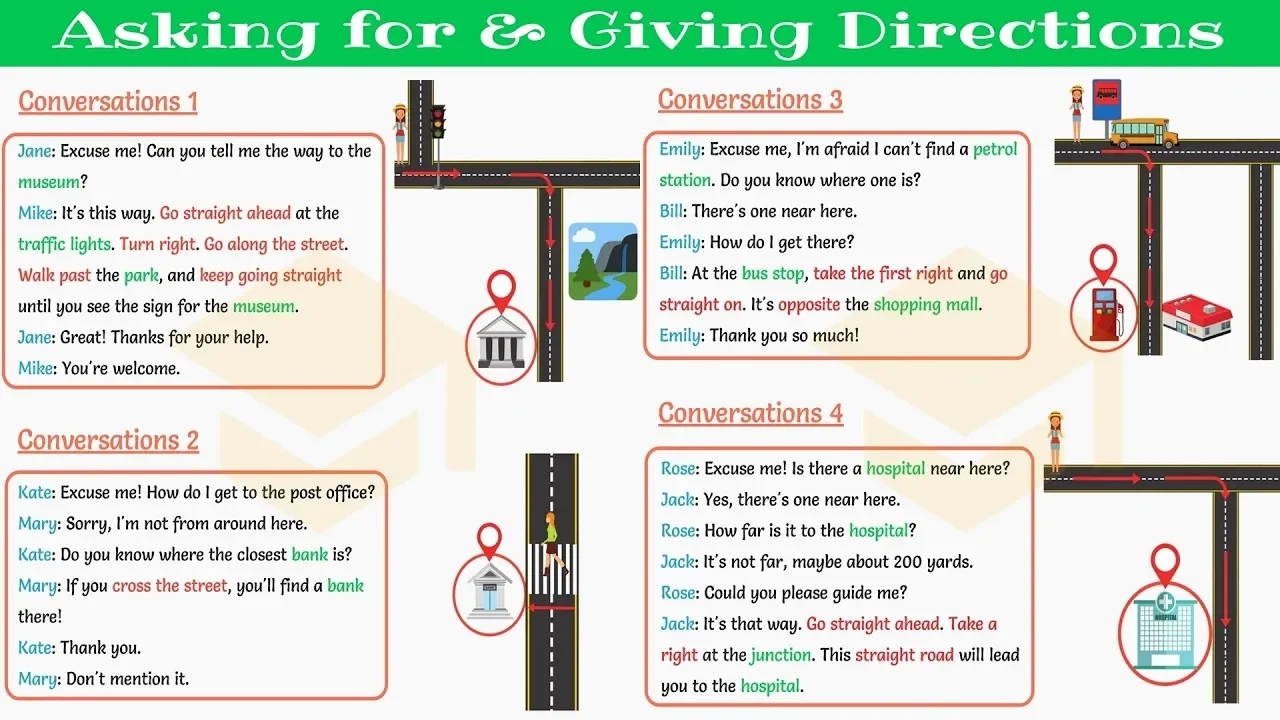
When giving directions, you often use phrases like, turn left, or, turn right, to tell someone to change direction.
Al dar indicaciones, a menudo usas frases como 'gira a la izquierda' o 'gira a la derecha' para decirle a alguien que cambie de dirección.
For example, turn left at the traffic light.
Por ejemplo, gira a la izquierda en el semáforo.
If you want someone to continue without turning, you say, go straight ahead, like, go straight ahead for two blocks.
Si quieres que alguien continúe sin girar, dices 'sigue recto', como 'sigue recto por dos manzanas'.
You can also describe locations using, at the corner of, which means a place is where two streets meet, such as, the cafe is at the corner of Main Street and First Avenue.
También puedes describir ubicaciones usando 'en la esquina de', lo que significa que un lugar está donde se encuentran dos calles, como 'la cafetería está en la esquina de la Calle Principal y la Primera Avenida'.
If something is right next to another place, you can say, next to, or, beside, like, the bank is next to the supermarket.
Si algo está justo al lado de otro lugar, puedes decir "al lado de" o "junto a", como por ejemplo: el banco está al lado del supermercado.
When a place is in the middle of two others, you use between A and B, for example, the pharmacy is between the post office and the bookstore.
Cuando un lugar está en medio de otros dos, usas "entre A y B", por ejemplo: la farmacia está entre la oficina de correos y la librería.
Using these phrases makes giving and understanding directions much easier.
Usar estas frases hace que dar y entender indicaciones sea mucho más fácil.
Hello Mr. Police Officer, could you help me?
Hola, señor policía, ¿podría ayudarme?
I'm looking for the post office.
Estoy buscando la oficina de correos.
Of course.
Por supuesto.
Go straight ahead for two blocks, then turn right at the corner.
Siga recto durante dos manzanas y luego gire a la derecha en la esquina.
The post office is next to the pharmacy.
La oficina de correos está junto a la farmacia.
So, I go straight for two blocks, then turn right at the corner.
Entonces, sigo recto dos manzanas y luego giro a la derecha en la esquina.
The post office will be beside the pharmacy?
¿La oficina de correos estará junto a la farmacia?
Yes, exactly.
Sí, exactamente.
Oh, I see.
Ah, entiendo.
If you see the gas station, you need to turn around and go back.
Si ves la gasolinera, necesitas dar media vuelta y volver.
The post office is between the pharmacy and the bakery.
La oficina de correos está entre la farmacia y la panadería.
Between the pharmacy and the bakery.
Entre la farmacia y la panadería.
Got it.
Entendido.
Is there a bus stop nearby?
¿Hay una parada de autobús cerca?
If you're coming by bus, get off at the first stop after the supermarket.
Si vienes en autobús, bájate en la primera parada después del supermercado.
That's helpful.
Eso es útil.
What if I'm coming from the train station?
¿Y si vengo desde la estación de tren?
From the train station, go straight ahead until you see a bank on your left.
Desde la estación de tren, siga recto hasta que vea un banco a su izquierda.
At the corner, turn left, then walk past the supermarket.
En la esquina, gire a la izquierda y luego pase caminando el supermercado.
The post office is next to the pharmacy.
La oficina de correos está junto a la farmacia.
So from the train station, I go straight, turn left at the corner near the bank, go past the supermarket, and the post office is beside the pharmacy?
Entonces, desde la estación de tren, sigo recto, giro a la izquierda en la esquina cerca del banco, paso el supermercado y la oficina de correos está junto a la farmacia?
Yes, you got it.
Sí, lo has entendido bien.
Perfect.
Perfecto.
Thank you so much for your help.
Muchas gracias por su ayuda.
You're welcome.
De nada.
Have a great day.
Que tenga un excelente día.
You too.
Igualmente.
Now let's learn the names of common places you might ask for directions to.
Ahora aprendamos los nombres de lugares comunes a los que podrías pedir indicaciones.
Section 3.
Sección 3.
Common Places and Landmarks
Lugares Comunes y Referencias
When asking for directions, it's useful to know the names of common places.
Al pedir indicaciones, es útil conocer los nombres de lugares comunes.
Let's look at some important locations.
Veamos algunas ubicaciones importantes.
Some important locations to be familiar with include essential services like hospitals, police stations, and pharmacies, which can be helpful in emergencies.
Algunas ubicaciones importantes que debes conocer incluyen servicios esenciales como hospitales, comisarías y farmacias, que pueden ser útiles en emergencias.
For travel and transportation, knowing the locations of airports, train stations, bus stops, and gas stations is important.
Para viajar y transportarse, es importante conocer las ubicaciones de aeropuertos, estaciones de tren, paradas de autobús y gasolineras.
Additionally, banks, shopping malls, and restaurants are key places for daily activities, whether you need to withdraw money, buy groceries, or have a meal.
Además, los bancos, centros comerciales y restaurantes son lugares clave para actividades diarias, ya sea que necesites retirar dinero, comprar víveres o comer.
For leisure, cinemas and parks provide great options for entertainment and relaxation.
Para el ocio, los cines y los parques ofrecen excelentes opciones para entretenimiento y relajación.
Being aware of these places will make navigating a new area much easier.
Conocer estos lugares facilitará mucho la navegación por una zona nueva.
Excuse me, could you help me?
Disculpe, ¿podría ayudarme?
I need to go to the hospital, but I'm not sure how to get there.
Necesito ir al hospital, pero no estoy seguro de cómo llegar.
Of course.
Por supuesto.
The hospital is not too far from here.
El hospital no está muy lejos de aquí.
Do you see that park with a fountain?
¿Ve ese parque con una fuente?
Yes, I do.
Sí, lo veo.
Great.
Genial.
From the mall, just walk straight through the park until you reach the intersection with the police station.
Desde el centro comercial, siga recto a través del parque hasta llegar a la intersección donde está la comisaría.
Don't walk past the police station.
No pase de largo la comisaría.
Instead, turn right at this intersection.
En su lugar, gire a la derecha en esta intersección.
Keep walking past two buildings, and you will reach another intersection.
Siga caminando pasando dos edificios y llegará a otra intersección.
The hospital will be on your left.
El hospital estará a su izquierda.
Okay, so walk straight to the police station.
Entendido, entonces sigo recto hasta la comisaría.
Turn right before passing it and go two blocks.
Giro a la derecha antes de pasarla y camino dos cuadras.
Got it.
Entendido.
Thanks so much.
Muchas gracias.
You're welcome.
De nada.
Sorry to bother you again, but is there a pharmacy near the hospital?
Perdón por molestarle de nuevo, pero ¿hay una farmacia cerca del hospital?
No problem.
No hay problema.
Yes, there's a pharmacy right behind the hospital.
Sí, hay una farmacia justo detrás del hospital.
After you leave the hospital, walk to the back of the building, and you'll see the pharmacy there.
Después de salir del hospital, camine hacia la parte trasera del edificio y verá la farmacia allí.
That's perfect.
Eso es perfecto.
Perfect.
Perfecto.
I'll go there after my hospital visit.
Iré allí después de mi visita al hospital.
Thank you so much.
Muchas gracias.
Have a good day.
Que tenga un buen día.
You too.
Igualmente.
Hello.
Hola.
You look like you're trying to find a place.
Parece que está buscando un lugar.
Hello, that's right.
Hola, así es.
I just visited a friend at the hospital, and now I need to get to the airport.
Acabo de visitar a un amigo en el hospital y ahora necesito llegar al aeropuerto.
Oh.
Oh.
If you need to go to the airport, you can take a bus or even walk there.
Si necesita ir al aeropuerto, puede tomar un autobús o incluso caminar hasta allá.
The airport is about 15 minutes from the hospital.
El aeropuerto está a unos 15 minutos del hospital.
A bus?
¿Un autobús?
Do you know where the nearest bus stop is?
¿Sabe dónde está la parada de autobús más cercana?
Yes.
Sí.
From the hospital's main entrance, turn right and walk 100 meters to the first intersection.
Desde la entrada principal del hospital, gire a la derecha y camine 100 metros hasta la primera intersección.
Then, turn right onto the road beside the hospital, walk another 50 meters, and you'll see the bus stop.
Luego, gire a la derecha hacia la carretera que está junto al hospital, camine otros 50 metros y verá la parada de autobús.
That's great.
Eso es genial.
How often do buses go to the airport?
¿Con qué frecuencia pasan los autobuses al aeropuerto?
Every 5 minutes, there's a bus number 50 that goes directly to the airport.
Cada 5 minutos pasa el autobús número 50 que va directamente al aeropuerto.
Thank you so much, this is really helpful.
Muchas gracias, esto es realmente útil.
What if I want to take a train next time, is the train station nearby?
¿Y si la próxima vez quiero tomar un tren? ¿Está cerca la estación de trenes?
Yes, the train station is quite close.
Sí, la estación de trenes está bastante cerca.
Since this is the city center, the airport, train station, and bus stops are all nearby.
Como esto es el centro de la ciudad, el aeropuerto, la estación de trenes y las paradas de autobús están todos cerca.
That's convenient, how do I get there?
Qué conveniente, ¿cómo llego allí?
From the bus stop I showed you earlier, just keep walking straight and past two intersections.
Desde la parada de autobús que te mostré antes, sigue caminando en línea recta y pasa dos intersecciones.
Then, continue walking straight until you reach a big three-way junction.
Luego, continúa caminando en línea recta hasta llegar a una gran intersección de tres vías.
At that junction, turn left and walk about 100 meters, and you'll see the train station.
En esa intersección, gira a la izquierda y camina unos 100 metros, y verás la estación de trenes.
Got it, is there a bus that goes there?
Entendido, ¿hay un autobús que vaya allí?
Yes.
Sí.
If you prefer the bus, take bus number 10 to the train station.
Si prefieres el autobús, toma el autobús número 10 hacia la estación de trenes.
Oh, that's great.
Oh, eso es genial.
Thank you so much for your help.
Muchas gracias por tu ayuda.
You're welcome.
De nada.
Have a great day.
Que tengas un excelente día.
Jaden, I'm done with work.
Jaden, ya terminé el trabajo.
Where are you?
¿Dónde estás?
Oh, you're done.
Oh, ya terminaste.
I'm waiting for you at a restaurant.
Te estoy esperando en un restaurante.
Let's have lunch together and then go watch a movie.
Vamos a almorzar juntos y luego vamos a ver una película.
Sounds good.
Suena bien.
But which restaurant are you at?
Pero, ¿en qué restaurante estás?
If you're in front of the bank, cross the street, and you'll see a yellow building.
Si estás frente al banco, cruza la calle y verás un edificio amarillo.
Go inside and take the elevator to the third floor.
Entra y toma el ascensor hasta el tercer piso.
I'm at a Korean barbecue restaurant there.
Estoy en un restaurante de barbacoa coreana ahí.
Got it.
Entendido.
Wait for me five minutes.
Espérame cinco minutos.
After we eat, which movie theater are we going to?
Después de comer, ¿a qué cine iremos?
I don't know the way.
No sé el camino.
It's really close.
Está muy cerca.
Once we're done eating, we'll head over there.
Una vez que terminemos de comer, nos dirigiremos allá.
From the restaurant, turn right and go past the first intersection.
Desde el restaurante, gira a la derecha y pasa la primera intersección.
Keep going straight, and at the second intersection, turn left.
Sigue recto y, en la segunda intersección, gira a la izquierda.
The movie theater is in the first building.
El cine está en el primer edificio.
Oh, I see.
Ah, entiendo.
So I need to turn right from the restaurant, continue straight past the first intersection, and then turn left at the second one.
Entonces necesito girar a la derecha desde el restaurante, seguir recto pasando la primera intersección y luego girar a la izquierda en la segunda.
The theater will be in the first building, right?
El teatro estará en el primer edificio, ¿verdad?
Exactly.
Exactamente.
You got it.
Entendido.
And if I want to take a walk in a park after the movie, is there one nearby?
Y si quiero dar un paseo por un parque después de la película, ¿hay alguno cerca?
Yes.
Sí.
The park is just behind the cinema.
El parque está justo detrás del cine.
There's a small pathway that leads to it.
Hay una pequeña senda que lleva hasta allí.
That's wonderful.
Qué maravilloso.
A perfect way to end the day.
Una forma perfecta de terminar el día.
Thanks again, Jayden.
Gracias de nuevo, Jayden.
Now that you know common places, let's practice how to ask for directions politely.
Ahora que ya conoces los lugares comunes, practiquemos cómo pedir indicaciones de manera educada.
Asking for directions politely.
Pedir indicaciones con educación.
When you're in an unfamiliar place, asking for directions can be very helpful.
Cuando estás en un lugar desconocido, pedir indicaciones puede ser muy útil.
However, it's important to be polite when making a request.
Sin embargo, es importante ser educado al hacer una petición.
Starting with phrases like, excuse me, or, can you help me, makes your question sound more courteous.
Empezar con frases como "disculpe" o "¿puede ayudarme?" hace que tu pregunta suene más cortés.
Here are some common ways to ask for directions.
Aquí tienes algunas formas comunes de pedir indicaciones.
Excuse me, could you please tell me the way to the train station?
Disculpe, ¿podría decirme por favor cómo llegar a la estación de tren?
Sure.
Claro.
Walk straight and turn left at the 2nd street.
Siga recto y gire a la izquierda en la segunda calle.
I see.
Ya veo.
Thank you.
Gracias.
Honey, do you know where the nearest pharmacy is?
Cariño, ¿sabes dónde está la farmacia más cercana?
Yes, it's next to the supermarket on Main Street.
Sí, está junto al supermercado en la Calle Principal.
Oh, I see.
Oh, ya veo.
I'll buy some medicine and then stop by the store to pick you up.
Compraré algo de medicina y luego pasaré por la tienda para recogerte.
All right.
Muy bien.
See you soon.
Nos vemos pronto.
Hey Sam, what's the best way to get to the airport?
Oye Sam, ¿cuál es la mejor forma de llegar al aeropuerto?
Taking the express train is the fastest option.
Tomar el tren expreso es la opción más rápida.
Oh, that's good to know.
Oh, qué bueno saberlo.
By the way, is there a bank nearby?
Por cierto, ¿hay algún banco cerca?
Yes, it's two blocks ahead, next to the gas station.
Sí, está a dos manzanas hacia adelante, junto a la gasolinera.
Thanks.
Gracias.
Oh, one more thing.
Oh, otra cosa.
Which way should I go to reach the police station?
¿Por qué camino debo ir para llegar a la comisaría?
Go straight and turn right at the next intersection.
Siga recto y gire a la derecha en la siguiente intersección.
You'll see it on your left.
Lo verás a tu izquierda.
Got it.
Entendido.
Thanks for your help, Sam.
Gracias por tu ayuda, Sam.
You're welcome.
De nada.
Excuse me.
Disculpe.
How far is the hospital from here?
¿A qué distancia está el hospital desde aquí?
It's about a 10-minute walk from here.
Está a unos 10 minutos caminando desde aquí.
Oh, I see.
Ah, entiendo.
Can you point me in the direction of the hospital?
¿Puede indicarme la dirección del hospital?
Sure.
Claro.
Just go straight down this road and turn left at the second intersection.
Siga recto por esta calle y gire a la izquierda en la segunda intersección.
Got it.
Entendido.
Am I going the right way to the hospital if I pass by the supermarket?
¿Voy por el camino correcto hacia el hospital si paso por el supermercado?
Yes, exactly.
Sí, exactamente.
Keep going past the supermarket and you'll see the hospital on your right.
Siga pasando el supermercado y verá el hospital a su derecha.
Thank you so much.
Muchas gracias.
You're welcome.
De nada.
Great!
¡Genial!
Let's review what we've learned today.
Repasemos lo que hemos aprendido hoy.
We covered basic direction words, how to give and understand directions, commonplaces, and polite phrases for asking directions.
Cubrimos palabras básicas de dirección, cómo dar y entender instrucciones, lugares comunes y frases corteses para pedir direcciones.
Now, you can confidently talk about directions and locations in English.
Ahora puedes hablar con confianza sobre direcciones y ubicaciones en inglés.
Keep practicing by asking for and giving directions in real-life situations.
Sigue practicando pidiendo y dando direcciones en situaciones de la vida real.
questions.
preguntas.