Hi friends!
Olá, amigos!
Welcome back to Daily English Talk.
Sejam bem-vindos de volta ao Daily English Talk.
I'm Lily.
Eu sou a Lily.
And I'm Tom.
E eu sou o Tom.
Good to see you again.
Que bom ver vocês novamente.
If you're new here, welcome to the family.
Se você é novo aqui, seja bem-vindo à família.
We're so happy you found us.
Estamos muito felizes que você nos encontrou.
And if you're not new, welcome back.
E se você não é novo, sejam bem-vindos de volta.
You already know how this works.
Você já sabe como isso funciona.
Do you have a return ticket?
Você tem uma passagem de ida e volta?
What is the purpose of your trip?
Qual é o propósito da sua viagem?
A return ticket?
Uma passagem de ida e volta?
No, I don't.
Não, não tenho.
I'm going for fun.
Vou a passeio.
Every single day, we post a new English lesson to help you speak with more confidence.
Todos os dias, postamos uma nova lição de inglês para ajudar você a falar com mais confiança.
So if you want to learn real, natural English, hit that subscribe button right now.
Então, se você quer aprender inglês real e natural, clique no botão de inscrição agora mesmo.
It's free, it's daily, and it really helps the channel grow.
É grátis, é diário e realmente ajuda o canal a crescer.
Today, we have a fun one.
Hoje, temos uma divertida.
We're going to teach you airport English.
Vamos ensinar inglês para aeroporto.
Yes, everything you need to say at the airport, from check-in all the way to passport control.
Sim, tudo o que você precisa dizer no aeroporto, desde o check-in até o controle de passaportes.
And here's the best part.
E aqui está a melhor parte.
Last week, Tom and I actually took a real trip.
Na semana passada, o Tom e eu fizemos uma viagem real.
We flew from the United States to the United Kingdom.
Nós voamos dos Estados Unidos para o Reino Unido.
From the USA to the UK.
Dos EUA para o Reino Unido.
And let me tell you, a lot of things happened.
E deixa eu te contar, muitas coisas aconteceram.
Oh, a lot of things happened to you, Tom.
Ah, muitas coisas aconteceram com você, Tom.
That's true.
É verdade.
That's very true.
Isso é muito verdade.
Tom, we have a new member.
Tom, temos um novo membro.
His name is Nguyen Suan Kwong.
O nome dele é Nguyen Suan Kwong.
Oh, I'm happy now.
Ah, estou feliz agora.
Congratulations, Nguyen Suan Kwong.
Parabéns, Nguyen Suan Kwong.
So today, you'll learn the words and phrases, and you'll hear a real story at the same time.
Então hoje, você aprenderá as palavras e frases, e ouvirá uma história real ao mesmo tempo.
This is perfect for level A2 to B1.
Isso é perfeito para o nível A2 ao B1.
Let's go.
Vamos lá.
Okay, before we start the story, I have a question for all of you watching.
Ok, antes de começarmos a história, tenho uma pergunta para todos vocês que estão assistindo.
Uh-oh.
Ué.
I think I know where this is going.
Acho que sei para onde isso vai.
At the airport in New York, Tom's suitcase was too heavy.
No aeroporto em Nova York, a mala do Tom estava pesada demais.
Way too heavy.
Muito pesada.
So he had to pay extra money for it.
Então ele teve que pagar dinheiro extra por isso.
Please don't tell them the number.
Por favor, não diga o valor a eles.
I won't tell them.
Eu não vou dizer.
That's the fun part.
Essa é a parte divertida.
Here's the question for you, everyone at home.
Aqui está a pergunta para você, todos em casa.
How much extra money do you think Tom had to pay for his heavy bag?
Quanto dinheiro extra você acha que Tom teve que pagar pela mala pesada?
It was a lot.
Foi bastante.
I'll just say that.
Vou só dizer isso.
Take a guess and write it in the comments right now.
Chute e escreva nos comentários agora mesmo.
Was it $20, $50, $100, even more?
Foi $20, $50, $100, ou até mais?
More.
Mais.
Tom, don't help them.
Tom, não ajude eles.
Sorry, sorry.
Desculpe, desculpe.
So put your guess in the comments.
Então coloque seu chute nos comentários.
We're not telling you the answer today.
Não vamos dizer a resposta hoje.
We want to see who gets the closest.
Queremos ver quem chega mais perto.
Ready?
Pronto?
Let's hear the whole story.
Vamos ouvir a história toda.
So, Tom, this was your first time flying to another country, right?
Então, Tom, essa foi sua primeira vez voando para outro país, certo?
Yes, my very first big international trip.
Sim, minha primeira grande viagem internacional.
I was so excited.
Estava tão animado.
I packed my bag two weeks early.
Empacotei minha mala duas semanas antes.
Two weeks early.
Duas semanas antes.
And that's the problem, isn't it?
E esse é o problema, não é?
You're right.
Você está certo.
When you pack early, you keep adding things.
Quando você faz as malas com antecedência, continua adicionando coisas.
A few shirts, then some shoes, then snacks.
Algumas camisas, depois alguns sapatos, depois lanches.
So many snacks.
Tantos lanches.
Tom packed American snacks to share with our friends in London.
Tom embalou lanches americanos para compartilhar com nossos amigos em Londres.
You're right.
Você está certo.
They asked for them.
Eles pediram por eles.
Cookies, chips, candy.
Biscoitos, batatas chips, doces.
I couldn't say no.
Eu não consegui dizer não.
It was very kind, but your bag became so heavy.
Foi muito gentil, mas sua bagagem ficou tão pesada.
I know.
Eu sei.
I couldn't even lift it at the end.
Eu mal conseguia levantá-la no final.
And the airport was busy that day, too.
E o aeroporto também estava cheio naquele dia.
So many people, so many bags.
Tantas pessoas, tantas bagagens.
Huge lines everywhere.
Filas enormes por toda parte.
But honestly, the whole trip was amazing.
Mas, honestamente, a viagem toda foi incrível.
The flight, the food, landing in London.
O voo, a comida, o pouso em Londres.
It was a wonderful trip.
Foi uma viagem maravilhosa.
We had two small problems, but we learned so much.
Tivemos dois pequenos problemas, mas aprendemos muito.
Small problems.
Pequenos problemas.
One was my heavy bag, and the other one was at passport control.
Um era minha bagagem pesada, e o outro foi no controle de passaportes.
Oh, yes.
Ah, sim.
Tom and the passport officer.
Tom e o agente de imigração.
We'll get to that.
Chegaremos a isso.
I'm not ready to talk about it, but okay.
Não estou pronto para falar sobre isso, mas tudo bem.
Don't worry, everyone.
Não se preocupem, pessoal.
These problems are very common, and after this lesson, you'll know exactly what to do.
Esses problemas são muito comuns e, após esta aula, vocês saberão exatamente o que fazer.
Let's learn some grammar first.
Vamos aprender um pouco de gramática primeiro.
Okay, let's talk about a useful grammar point for travel.
Ok, vamos falar sobre um ponto gramatical útil para viagens.
It's the present perfect.
É o present perfect (pretérito perfeito composto).
The present perfect.
O present perfect.
When do we use it?
Quando usamos ele?
We use it to talk about experiences in our life when we don't say the exact time.
Usamos para falar sobre experiências em nossa vida quando não dizemos o tempo exato.
We make it like this.
Formamos assim.
We use have or has plus the past participle of the verb.
Usamos have ou has mais o particípio passado do verbo.
Give us an example.
Dê-nos um exemplo.
I have been to England.
Eu já estive na Inglaterra.
That means at some time in my life, I went there.
Isso significa que, em algum momento da minha vida, eu fui lá.
Maybe last year, maybe ten years ago.
Talvez no ano passado, talvez há dez anos.
The time is not important.
A hora não é importante.
Oh, I like that one.
Ah, eu gostei dessa.
I have been to England.
Eu estive na Inglaterra.
Now I can finally say it.
Agora posso finalmente dizer isso.
Yes, you can.
Sim, você pode.
And we often ask people, have you ever been to another country?
E muitas vezes perguntamos às pessoas: você já esteve em outro país?
So I could say, have you ever flown on a plane?
Então eu poderia dizer: você já voou de avião alguma vez?
Perfect.
Perfeito.
And before our trip, here's a true sentence.
E antes da nossa viagem, aqui está uma frase verdadeira.
Tom had never traveled abroad before.
Tom nunca tinha viajado para o exterior antes.
We use never for zero experience.
Usamos 'never' (nunca) para zero experiência.
Sad but true.
Triste, mas verdade.
Zero experience.
Zero experiência.
That's me.
Sou eu.
But listen, this is different from the past simple.
Mas escute, isso é diferente do past simple (passado simples).
When we say the exact time, we use the past simple.
Quando dizemos a hora exata, usamos o past simple.
For example, last week we flew to London.
Por exemplo, na semana passada voamos para Londres.
That's a finished action with a clear time.
Essa é uma ação concluída com um tempo claro.
So present perfect for the experience and past simple for the exact time.
Então, present perfect para a experiência e past simple para a hora exata.
Exactly.
Exatamente.
Let me show you both together.
Deixe-me mostrar os dois juntos.
I have been to London.
Eu estive em Londres.
That's the experience.
Essa é a experiência.
I went to London last week.
Fui para Londres na semana passada.
That's the specific trip.
Essa é a viagem específica.
That's so clear.
Isso é muito claro.
Now, here's a question for everyone watching.
Agora, aqui está uma pergunta para todos que estão assistindo.
Have you ever traveled to another country?
Você já viajou para outro país?
Write, yes, I have, or no, I haven't in the comments.
Escreva 'sim, eu estive' ou 'não, eu não estive' nos comentários.
Practice the grammar with us.
Pratique a gramática conosco.
Don't be shy.
Não seja tímido.
Try it.
Tente.
Okay, now the most important part.
Ok, agora a parte mais importante.
Let's learn the real airport English, step by step, in the same order you use it at the airport.
Vamos aprender o inglês real do aeroporto, passo a passo, na mesma ordem em que você o usa no aeroporto.
From the front door to the airplane.
Da porta de entrada até o avião.
Let's do it.
Vamos fazer isso.
First, you arrive at the airport and you go to the check-in desk.
Primeiro, você chega ao aeroporto e vai ao balcão de check-in.
This is where you give your bag and you get your boarding pass.
É ali onde você entrega sua mala e recebe seu cartão de embarque.
And the boarding pass is the small ticket, right?
E o cartão de embarque é aquele pequeno bilhete, certo?
The one with your seat and your gate number.
Aquele com seu assento e o número do portão.
Exactly.
Exatamente.
Let me show you a normal conversation.
Deixe-me mostrar uma conversa normal.
Listen.
Ouça.
Good morning.
Bom dia.
Here is my passport.
Aqui está meu passaporte.
Thank you.
Obrigado.
Where are you flying today?
Para onde você vai voar hoje?
I'm flying to London.
Estou voando para Londres.
Great.
Ótimo.
Here is your boarding pass.
Aqui está seu cartão de embarque.
Your gate is number 22.
Seu portão é o número 22.
See how simple that is?
Veja como isso é simples?
Just a few clear sentences.
Apenas algumas frases claras.
You don't need difficult words.
Você não precisa de palavras difíceis.
Here is my passport.
Aqui está meu passaporte.
I can remember that one.
Posso lembrar dessa.
Now, number two, this is Tom's favorite word, excess baggage.
Agora, número dois, esta é a palavra favorita do Tom: bagagem excessiva.
Oh, no.
Ah, não.
Excess baggage means your bag is too heavy or too big.
Bagagem excessiva significa que sua mala está pesada demais ou grande demais.
The airport word is overweight.
A palavra do aeroporto é sobrepeso.
If your bag is overweight, you pay an extra fee.
Se sua mala estiver com sobrepeso, você paga uma taxa extra.
A fee is money you must pay.
Uma taxa é o dinheiro que você deve pagar.
And my bag was very overweight.
E minha mala estava muito pesada.
Let's act it out.
Vamos encenar isso.
Listen carefully.
Ouça com atenção.
Sir, I'm sorry, but your bag is overweight.
Senhor, sinto muito, mas sua mala está com sobrepeso.
Oh no.
Ah, não.
How heavy is it?
Quanto ela pesa?
It's too heavy.
Está pesada demais.
You'll need to pay an extra fee or you can remove some items.
Você precisará pagar uma taxa extra ou pode remover alguns itens.
So that was the moment.
Então esse foi o momento.
I had to choose.
Eu tive que escolher.
Pay the money or take things out of my bag.
Pagar o dinheiro ou tirar coisas da minha mala.
And remember, everyone, we're not telling you how much he paid.
E lembrem-se, pessoal, não estamos dizendo quanto ele pagou.
Keep guessing in the comments.
Continuem adivinhando nos comentários.
Please be nice with your guesses.
Por favor, sejam gentis com suas suposições.
Number three.
Número três.
There are two kinds of bags.
Existem dois tipos de malas.
Your checked bag goes under the plane.
Sua mala despachada vai por baixo do avião.
Your carry-on bag or hand luggage stays with you on the plane.
Sua bagagem de mão ou mala de cabin fica com você no avião.
And here's my smart idea.
E aqui está minha ideia inteligente.
To make my checked bag lighter, I put more things in my carry-on bag.
Para deixar minha mala despachada mais leve, coloquei mais coisas na minha bagagem de mão.
His carry-on was so full, he couldn't close it.
A bagagem de mão estava tão cheia que ele não conseguia fechá-la.
It closed eventually.
Ele conseguiu fechar eventualmente.
I sat on it.
Eu sentei em cima dela.
He sat on his own bag in the middle of the airport.
Ele sentou na própria mala no meio do aeroporto.
Lesson learned.
Lição aprendida.
Pack light, everybody.
Viajem com pouco, pessoal.
Number four.
Número quatro.
After check-in, you go to security.
Após o check-in, você vai para a segurança.
At security, they check you and your bags.
Na segurança, eles verificam você e suas malas.
They often say, please remove your laptop or please take off your belt.
Eles frequentemente dizem: por favor, retire seu laptop ou por favor, tire seu cinto.
The belt.
O cinto.
Oh, the belt.
Ah, o cinto.
Tell him, Tom.
Conte isso, Tom.
I took off my belt for the security check, and then my pants started to fall down a little.
Tirei meu cinto para a inspeção de segurança e, então, minhas calças começaram a cair um pouco.
In front of everyone.
Na frente de todo mundo.
He was holding his pants with one hand and his bag with the other.
Ele segurava as calças com uma mão e a mala com a outra.
It was not my best moment.
Não foi meu melhor momento.
But the phrases are useful.
Mas as frases são úteis.
Please remove your laptop.
Por favor, retire seu laptop.
Please take off your shoes.
Por favor, tire seus sapatos.
Now you'll understand the officer.
Agora você entenderá o agente.
Number five.
Número cinco.
The gate is the door where you get on the plane.
O portão é a porta por onde você entra no avião.
When it's time to enter the plane, we say boarding.
Quando chega a hora de entrar no avião, dizemos embarque.
And what's a final call?
E o que é chamada final?
Good question.
Boa pergunta.
Final call means hurry.
Chamada final significa pressa.
This is the last chance to get on the plane.
Esta é a última chance de entrar no avião.
You hear it on the speakers.
Você ouve isso nos alto-falantes.
And we almost missed it.
E nós quase perdemos.
Because someone was buying more snacks.
Porque alguém estava comprando mais lanches.
I needed snacks for the flight.
Eu precisava de lanches para o voo.
We heard final call for the flight to Linden and we ran to the gate.
Ouimos a chamada final para o voo para Londres e corremos até o portão.
We ran so fast I dropped a bag of chips on the way.
Corremos tão rápido que deixei cair um saco de batatas chips pelo caminho.
Rest in peace, chips.
Descanse em paz, batatas chips.
Okay, number six.
Ok, número seis.
This is the big one.
Este é o grande momento.
When you arrive in a new country, you go to passport control, also called immigration.
Quando você chega a um novo país, vai ao controle de passaportes, também chamado de imigração.
The officer checks your passport and asks you some questions.
O agente verifica seu passaporte e faz algumas perguntas.
And this is where I had my problem.
E foi aí que tive meu problema.
The officer usually asks two questions.
O agente geralmente faz duas perguntas.
First, what's the purpose of your visit?
Primeiro, qual é o propósito da sua visita?
That means, why are you here?
Isso significa: por que você está aqui?
You can answer, I'm here on holiday.
Você pode responder: Estou aqui de férias.
Or, I'm here for business.
Ou: Estou aqui a trabalho.
And the second question?
E a segunda pergunta?
Clear.
Entendido.
How long are you staying?
Por quanto tempo você vai ficar?
You can answer, for one week.
Você pode responder: Por uma semana.
Or, for ten days.
Ou: Por dez dias.
Well, I got very nervous.
Bem, eu fiquei muito nervoso.
The officer looked at me and asked, How long are you staying?
O agente olhou para mim e perguntou: Por quanto tempo você vai ficar?
And what did you say?
E o que você disse?
I forgot every English word I ever learned.
Esqueci todas as palavras em inglês que já aprendi.
I just said, um, a few days, maybe a week.
Eu só disse: hum, alguns dias, talvez uma semana.
I don't know.
Não sei.
Soon.
Em breve.
Thank you.
Obrigado.
Soon.
Em breve.
Thank you.
Obrigado.
That's not even an answer.
Isso nem é uma resposta.
The officer just looked at me so confused.
O agente apenas me olhou tão confuso.
But here's the lesson, everyone.
Mas aqui está a lição, pessoal.
Stay calm and answer clearly.
Mantenha a calma e responda claramente.
I'm here on holiday for one week.
Estou aqui de férias por uma semana.
Short and simple.
Curto e simples.
Now I know.
Agora eu sei.
Next time I'll be ready.
Da próxima vez estarei pronto.
And don't be afraid of passport control.
E não tenha medo do controle de passaportes.
The officer is just doing their job.
O agente está apenas fazendo o trabalho dele.
Speak slowly and stay relaxed.
Fale devagar e mantenha-se relaxado.
Number seven.
Número sete.
After you get your bags, you go through customs.
Depois de pegar suas malas, você passa pela alfândega.
Sometimes an officer asks, do you have anything to declare?
Às vezes, um agente pergunta: Você tem algo a declarar?
What does declare mean?
O que significa declarar?
To declare means to tell the officer if you're carrying special things like a lot of food or expensive items.
Declarar significa informar ao agente se você está carregando coisas especiais, como muita comida ou itens caros.
If you have nothing special, you just say, no, nothing to declare.
Se você não tiver nada especial, basta dizer: Não, nada a declarar.
But I had all those snacks, so I panicked and said, I have cookies.
Mas eu tinha todos aqueles lanches, então entrei em pânico e disse: 'Tenho biscoitos.'
Is that bad?
Isso é ruim?
Are cookies illegal?
Biscoitos são ilegais?
He confessed to the cookies.
Ele confessou ter os biscoitos.
I thought I was in big trouble for snacks.
Eu achei que ia ter grandes problemas por causa dos lanches.
The officer just smiled and said it was fine.
O agente apenas sorriu e disse que estava tudo bem.
But now you know the word declare.
Mas agora você conhece a palavra declarar.
Very useful.
Muito útil.
And number eight, the last one.
E número oito, o último.
After customs, you collect your checked bag at the baggage claim.
Após a alfândega, você recolhe sua mala despachada na área de bagagens.
The bags come out on a big moving belt called a carousel.
As malas saem em uma esteira rolante grande chamada carrossel.
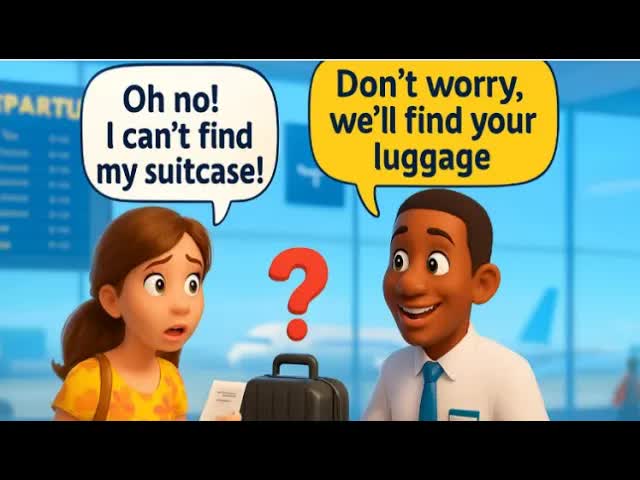
And we waited and waited for my heavy bag.
E nós esperamos e esperamos pela minha mala pesada.
His bag was so heavy, it was the very last one to come out.
A mala dele era tão pesada que foi a última a sair.
I thought the airline lost it.
Eu achei que a companhia aérea a tivesse perdido.
I was so worried.
Eu fiquei muito preocupado.
But it arrived.
Mas ela chegou.
And finally, we were ready to enjoy London.
E finalmente, estávamos prontos para aproveitar Londres.
Big Ben, here we come.
Big Ben, aqui vamos nós.
Okay, let's review everything we learned today.
Ok, vamos revisar tudo o que aprendemos hoje.
You did great.
Você fez ótimo trabalho.
Quick summary time.
Hora do resumo rápido.
First, you go to the check-in desk to get your boarding pass.
Primeiro, você vai ao balcão de check-in para pegar seu cartão de embarque.
Then watch out for excess baggage.
Depois, fique atento à bagagem excedente.
Don't let your bag be overweight or you pay an extra fee.
Não deixe sua mala ficar sobrepeso ou você pagará uma taxa extra.
Remember the two bag types.
Lembre-se dos dois tipos de malas.
The checked bag goes under the plane and the carry-on stays with you.
A mala despachada vai para baixo do avião e a de mão fica com você.
At security, they may say, please remove your laptop or take off your belt.
Na segurança, eles podem dizer: 'por favor, retire seu laptop' ou 'tire o cinto'.
You wait at the gate and you listen for boarding and final call.
Você espera no portão e escuta as chamadas de embarque e final.
At passport control, answer clearly.
No controle de passaportes, responda claramente.
I'm here on holiday for one week.
Estou aqui de férias por uma semana.
At customs, you might hear anything to declare.
Na alfândega, você pode ouvir: 'tem algo a declarar?'
And you collect your bag at package claim.
E você recolhe sua mala na área de bagagens.
That's everything you need for a smooth trip.
Isso é tudo o que você precisa para uma viagem tranquila.
And remember the grammar.
E lembre-se da gramática.
Present perfect for experiences.
Present perfect para experiências.
I have been to London.
I have been to London.
Past simple for the exact time.
Past simple para o tempo exato.
I went to London last week.
I went to London last week.
You can do this.
Você consegue fazer isso.
Travel English is not scary.
Inglês para viagens não é assustador.
It's just a few simple phrases.
São apenas algumas frases simples.
And that's our lesson for today.
E essa é a nossa lição de hoje.
Thank you so much for learning with us.
Muito obrigado por aprender conosco.
Now don't forget our big question.
Agora, não esqueça da nossa grande pergunta.
How much did I pay for my heavy bag?
Quanto eu paguei pela minha mala pesada?
We're not telling you today.
Não vamos revelar isso hoje.
Put your guess in the comments and let's see who gets the closest.
Deixe seu palpite nos comentários e vamos ver quem chega mais perto.
Be kind.
Sejam gentis.
It was a painful day for my wallet.
Foi um dia doloroso para a minha carteira.
If this lesson helped you, please hit that like button and subscribe to Daily English Talk.
Se esta lição ajudou você, clique no botão curtir e inscreva-se no Daily English Talk.
We post a brand new English lesson every single day.
Publicamos uma nova aula de inglês todos os dias.
Every day.
Todos os dias.
So you have a new way to practice your English all the time.
Assim, você tem uma nova maneira de praticar seu inglês o tempo todo.
practice a little every day and your English will grow stronger and stronger.
Pratique um pouco todos os dias e seu inglês ficará cada vez mais forte.
We believe in you.
Nós acreditamos em você.
You've got this.
Você consegue.
Keep speaking, keep smiling, and we'll see you in the next lesson.
Continue falando, continue sorrindo, e nos vemos na próxima lição.
Bye, everyone.
Tchau, pessoal.
Bye.
Tchau.
Safe travels.
Boas viagens.