Everyday English Essentials Welcome to Everyday English Essentials.
Essenciais de Inglês do Dia a Dia. Bem-vindo aos Essenciais de Inglês do Dia a Dia.
Today, we'll learn important words and phrases related to directions and locations.
Hoje, aprenderemos palavras e frases importantes relacionadas a direções e locais.
This will help you ask for and understand directions in daily life.
Isso ajudará você a pedir e entender direções no dia a dia.
Let's get started.
Vamos começar.
Section 1.
Seção 1.
Basic Direction Words
Palavras Básicas de Direção
First, let's start with some basic direction words.
Primeiro, vamos começar com algumas palavras básicas de direção.
These words will help you understand simple instructions.
Essas palavras ajudarão você a entender instruções simples.
When learning about directions in the English language, there are some common words you'll often hear and use when looking around for different places.
Ao aprender sobre direções em inglês, há algumas palavras comuns que você ouvirá e usará frequentemente ao procurar diferentes lugares.
These are useful for giving street directions in English, in particular.
Elas são úteis especialmente para dar direções nas ruas em inglês.
First, we learn left and right.
Primeiro, aprendemos esquerda e direita.
Left refers to the left-hand side, while right refers to the right-hand side.
Esquerda refere-se ao lado esquerdo, enquanto direita refere-se ao lado direito.
Straight means moving in a direct line without turning.
Direto significa mover-se em linha reta sem virar.
If you go forward, you move ahead in the direction in front of you.
Se você for para frente, avança na direção à sua frente.
In contrast, going backward means moving in the opposite direction.
Em contraste, ir para trás significa mover-se na direção oposta.
While straight describes a direct path, forward and backward indicate opposing movements, one advancing, the other retreating.
Enquanto direto descreve um caminho reto, para frente e para trás indicam movimentos opostos, um avançando, o outro recuando.
Let's go through a few examples to help you visualize it.
Vamos passar por alguns exemplos para ajudar você a visualizar isso.
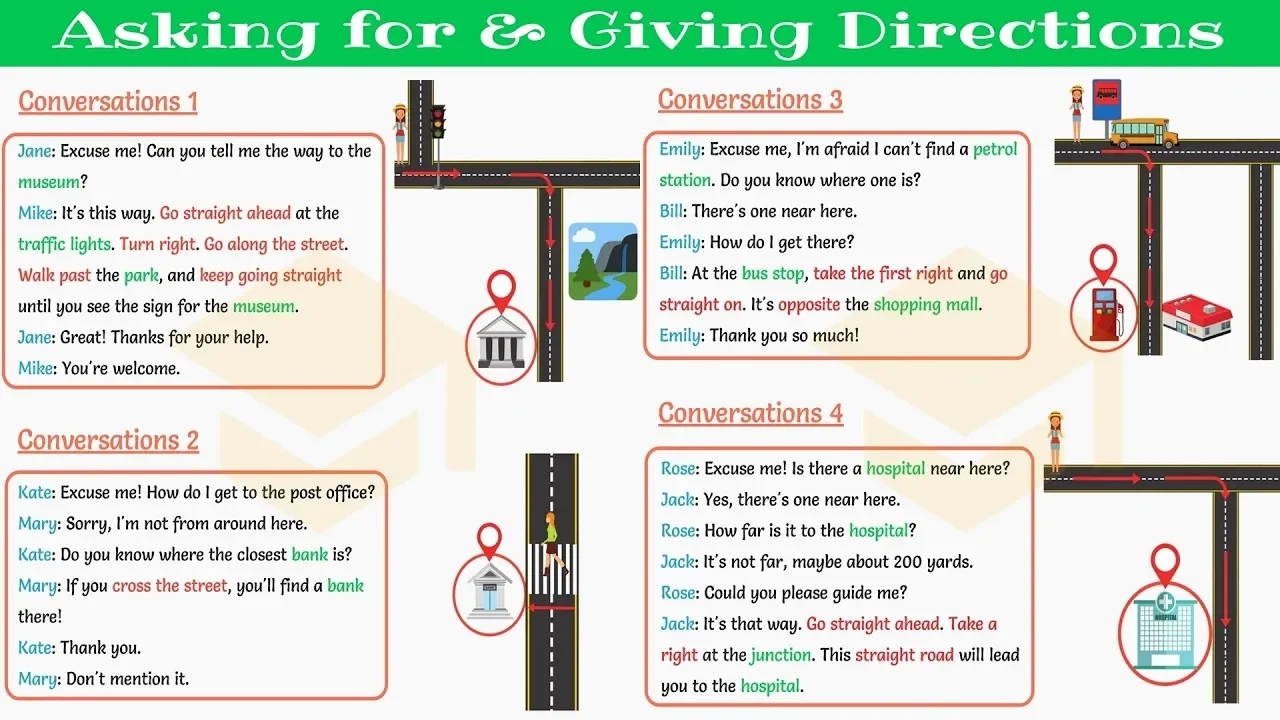
Excuse me, how can I get to the city library?
Com licença, como posso chegar à biblioteca da cidade?
Oh, go straight and turn left at the second street.
Ah, vá direto e vire à esquerda na segunda rua.
The library will be on your right.
A biblioteca estará à sua direita.
This is my first time here, so I'm not sure of the way.
Esta é minha primeira vez aqui, então não tenho certeza do caminho.
I go straight first, then turn left at the second street, right?
Vou direto primeiro, depois vire à esquerda na segunda rua, certo?
Yes, that's right.
Sim, está correto.
After turning left, walk for about 2 minutes, and you'll see the library on your right.
Após virar à esquerda, caminhe por cerca de 2 minutos e você verá a biblioteca à sua direita.
Got it.
Entendi.
Thank you so much.
Muito obrigado.
You're welcome.
De nada.
Excuse me, could you tell me how to get to the library?
Com licença, poderia me dizer como chegar à biblioteca?
Sure, just go straight until you reach the traffic light, then turn right.
Claro, basta ir direto até alcançar o semáforo e depois virar à direita.
So I go straight first, then turn right at the traffic light?
Então vou direto primeiro e depois vire à direita no semáforo?
That's right, after turning right, walk for about three minutes and you'll see a hotel on your left.
Isso mesmo, após virar à direita, caminhe por cerca de três minutos e você verá um hotel à sua esquerda.
The library is just past it.
A biblioteca fica logo depois dele.
Got it.
Entendi.
Thanks a lot.
Obrigado.
No problem.
Sem problemas.
Have a great day.
Tenha um ótimo dia.
Excuse me, could you tell me how to get to the hospital?
Com licença, poderia me dizer como chegar ao hospital?
Sure.
Claro.
Just keep walking straight from here.
Basta continuar andando em linha reta daqui.
Walk straight?
Caminhar em linha reta?
How far?
Até onde?
Go straight for about three houses.
Siga em frente por cerca de três casas.
You'll see a hotel on your right.
Você verá um hotel à sua direita.
Okay, so I walk straight for three blocks until I see a hotel.
Ok, então eu sigo em linha reta por três quarteirões até ver um hotel.
What do I do next?
O que faço a seguir?
After the hotel, keep going for another minute.
Depois do hotel, continue andando por mais um minuto.
The hospital will be on your right.
O hospital estará à sua direita.
So I don't need to turn anywhere, just keep walking straight?
Então não preciso virar em lugar nenhum, apenas continuar caminhando em linha reta?
That's right.
Isso mesmo.
Got it.
Entendi.
Thanks a lot.
Muito obrigado.
Hey, Bella, I think I missed the library.
Ei, Bella, acho que perdi a biblioteca.
Can you help me?
Pode me ajudar?
Where are you now?
Onde você está agora?
I'm in front of a hospital.
Estou em frente a um hospital.
Ah, you've gone a bit too far.
Ah, você foi um pouco longe demais.
You'll need to walk back.
Você precisará voltar andando.
Walk backward?
Voltar para trás?
How far?
Até onde?
Just go back about two minutes.
Volte por cerca de dois minutos.
You'll see a hotel on your left.
Você verá um hotel à sua esquerda.
Okay, so I walk back until I see a hotel.
Ok, então volto andando até ver um hotel.
Then what?
E depois?
After that, keep going a little further.
Depois disso, continue um pouco mais.
The library is right after the hotel.
A biblioteca fica logo após o hotel.
Oh, so I passed it without noticing?
Ah, então eu passei por ela sem perceber?
Yep.
Isso.
But no worries, just head back and you'll find it.
Mas não se preocupe, basta voltar e você a encontrará.
Got it.
Entendi.
Thanks for your help.
Obrigado pela ajuda.
You're welcome.
De nada.
Enjoy your time at the library.
Aproveite seu tempo na biblioteca.
Thanks.
Obrigado.
Have a great day.
Tenha um ótimo dia.
Now that you know basic direction words, let's learn how to give and understand directions in detail.
Agora que você conhece as palavras básicas de direção, vamos aprender como dar e entender direções em detalhes.
When giving directions, you often use phrases like, turn left, or, turn right, to tell someone to change direction.
Ao dar direções, você frequentemente usa frases como 'vire à esquerda' ou 'vire à direita' para indicar a alguém que mude de direção.
For example, turn left at the traffic light.
Por exemplo, vire à esquerda no semáforo.
If you want someone to continue without turning, you say, go straight ahead, like, go straight ahead for two blocks.
Se você quer que alguém continue sem virar, diga 'siga em frente', como 'siga em frente por dois quarteirões'.
You can also describe locations using, at the corner of, which means a place is where two streets meet, such as, the cafe is at the corner of Main Street and First Avenue.
Você também pode descrever localizações usando 'na esquina de', que significa que um lugar está onde duas ruas se encontram, como 'o café está na esquina da Rua Principal com a Primeira Avenida'.
If something is right next to another place, you can say, next to, or, beside, like, the bank is next to the supermarket.
Se algo estiver bem ao lado de outro lugar, você pode dizer 'ao lado' ou 'ao pé', como 'o banco fica ao lado do supermercado'.
When a place is in the middle of two others, you use between A and B, for example, the pharmacy is between the post office and the bookstore.
Quando um lugar está no meio de outros dois, você usa 'entre A e B', por exemplo, 'a farmácia fica entre a agência dos correios e a livraria'.
Using these phrases makes giving and understanding directions much easier.
Usar essas frases torna dar e entender direções muito mais fácil.
Hello Mr. Police Officer, could you help me?
Olá, Sr. Policial, o senhor poderia me ajudar?
I'm looking for the post office.
Estou procurando a agência dos correios.
Of course.
Claro.
Go straight ahead for two blocks, then turn right at the corner.
Siga em frente por duas quadras e depois vire à direita na esquina.
The post office is next to the pharmacy.
A agência dos correios fica ao lado da farmácia.
So, I go straight for two blocks, then turn right at the corner.
Então, eu sigo em frente por duas quadras e depois viro à direita na esquina?
The post office will be beside the pharmacy?
A agência dos correios ficará ao pé da farmácia?
Yes, exactly.
Sim, exatamente.
Oh, I see.
Ah, entendi.
If you see the gas station, you need to turn around and go back.
Se você vir o posto de gasolina, precisa dar meia-volta e voltar.
The post office is between the pharmacy and the bakery.
A agência dos correios fica entre a farmácia e a padaria.
Between the pharmacy and the bakery.
Entre a farmácia e a padaria.
Got it.
Entendi.
Is there a bus stop nearby?
Tem uma parada de ônibus por perto?
If you're coming by bus, get off at the first stop after the supermarket.
Se você vier de ônibus, desça na primeira parada após o supermercado.
That's helpful.
Isso é útil.
What if I'm coming from the train station?
E se eu estiver vindo da estação de trem?
From the train station, go straight ahead until you see a bank on your left.
Da estação de trem, siga em frente até ver um banco à sua esquerda.
At the corner, turn left, then walk past the supermarket.
Na esquina, vire à esquerda e passe pelo supermercado.
The post office is next to the pharmacy.
A agência dos correios fica ao lado da farmácia.
So from the train station, I go straight, turn left at the corner near the bank, go past the supermarket, and the post office is beside the pharmacy?
Então, da estação de trem, eu sigo em frente, viro à esquerda na esquina perto do banco, passo pelo supermercado e a agência dos correios fica ao pé da farmácia?
Yes, you got it.
Sim, acertou.
Perfect.
Perfeito.
Thank you so much for your help.
Muito obrigado pela ajuda.
You're welcome.
De nada.
Have a great day.
Tenha um ótimo dia.
You too.
O senhor também.
Now let's learn the names of common places you might ask for directions to.
Agora vamos aprender os nomes de lugares comuns para os quais você pode pedir direções.
Section 3.
Seção 3.
Common Places and Landmarks
Lugares Comuns e Pontos de Referência
When asking for directions, it's useful to know the names of common places.
Ao pedir direções, é útil conhecer os nomes de lugares comuns.
Let's look at some important locations.
Vamos olhar algumas localizações importantes.
Some important locations to be familiar with include essential services like hospitals, police stations, and pharmacies, which can be helpful in emergencies.
Algumas localizações importantes para se familiarizar incluem serviços essenciais como hospitais, delegacias de polícia e farmácias, que podem ser úteis em emergências.
For travel and transportation, knowing the locations of airports, train stations, bus stops, and gas stations is important.
Para viagens e transporte, saber as localizações de aeroportos, estações de trem, paradas de ônibus e postos de gasolina é importante.
Additionally, banks, shopping malls, and restaurants are key places for daily activities, whether you need to withdraw money, buy groceries, or have a meal.
Além disso, bancos, shoppings centers e restaurantes são locais-chave para atividades diárias, seja para sacar dinheiro, comprar mantimentos ou fazer uma refeição.
For leisure, cinemas and parks provide great options for entertainment and relaxation.
Para lazer, cinemas e parques oferecem ótimas opções de entretenimento e relaxamento.
Being aware of these places will make navigating a new area much easier.
Estar ciente desses lugares tornará a navegação em uma nova área muito mais fácil.
Excuse me, could you help me?
Com licença, poderia me ajudar?
I need to go to the hospital, but I'm not sure how to get there.
Preciso ir ao hospital, mas não sei como chegar lá.
Of course.
Claro.
The hospital is not too far from here.
O hospital não fica muito longe daqui.
Do you see that park with a fountain?
Você vê aquele parque com uma fonte?
Yes, I do.
Sim, vejo.
Great.
Ótimo.
From the mall, just walk straight through the park until you reach the intersection with the police station.
Do shopping, basta seguir em linha reta pelo parque até alcançar a interseção onde fica a delegacia de polícia.
Don't walk past the police station.
Não passe pela delegacia de polícia.
Instead, turn right at this intersection.
Em vez disso, vire à direita nesta interseção.
Keep walking past two buildings, and you will reach another intersection.
Continue andando passando por dois prédios e você chegará a outra interseção.
The hospital will be on your left.
O hospital estará à sua esquerda.
Okay, so walk straight to the police station.
Ok, então sigo em linha reta até a delegacia de polícia.
Turn right before passing it and go two blocks.
Vire à direita antes de passá-la e ande duas quadras.
Got it.
Entendi.
Thanks so much.
Muito obrigado.
You're welcome.
De nada.
Sorry to bother you again, but is there a pharmacy near the hospital?
Desculpe incomodar novamente, mas há uma farmácia perto do hospital?
No problem.
Sem problema.
Yes, there's a pharmacy right behind the hospital.
Sim, há uma farmácia bem atrás do hospital.
After you leave the hospital, walk to the back of the building, and you'll see the pharmacy there.
Depois que sair do hospital, caminhe até a parte de trás do prédio e você verá a farmácia lá.
That's perfect.
Isso é perfeito.
Perfect.
Perfeito.
I'll go there after my hospital visit.
Eu irei lá depois da minha visita ao hospital.
Thank you so much.
Muito obrigado.
Have a good day.
Tenha um bom dia.
You too.
Igualmente.
Hello.
Olá.
You look like you're trying to find a place.
Parece que você está tentando encontrar um lugar.
Hello, that's right.
Olá, isso mesmo.
I just visited a friend at the hospital, and now I need to get to the airport.
Acabei de visitar um amigo no hospital e agora preciso ir para o aeroporto.
Oh.
Ah.
If you need to go to the airport, you can take a bus or even walk there.
Se você precisa ir para o aeroporto, pode pegar um ônibus ou até ir a pé.
The airport is about 15 minutes from the hospital.
O aeroporto fica a cerca de 15 minutos do hospital.
A bus?
Um ônibus?
Do you know where the nearest bus stop is?
Você sabe onde está o ponto de ônibus mais próximo?
Yes.
Sim.
From the hospital's main entrance, turn right and walk 100 meters to the first intersection.
Da entrada principal do hospital, vire à direita e caminhe 100 metros até a primeira interseção.
Then, turn right onto the road beside the hospital, walk another 50 meters, and you'll see the bus stop.
Em seguida, vire à direita na estrada ao lado do hospital, caminhe mais 50 metros e você verá o ponto de ônibus.
That's great.
Isso é ótimo.
How often do buses go to the airport?
Com que frequência os ônibus vão para o aeroporto?
Every 5 minutes, there's a bus number 50 that goes directly to the airport.
A cada 5 minutos, há um ônibus número 50 que vai diretamente para o aeroporto.
Thank you so much, this is really helpful.
Muito obrigado, isso é realmente útil.
What if I want to take a train next time, is the train station nearby?
E se eu quiser pegar um trem da próxima vez, a estação ferroviária fica perto?
Yes, the train station is quite close.
Sim, a estação ferroviária fica bem perto.
Since this is the city center, the airport, train station, and bus stops are all nearby.
Como este é o centro da cidade, o aeroporto, a estação ferroviária e os pontos de ônibus estão todos nas proximidades.
That's convenient, how do I get there?
Que conveniente, como chego lá?
From the bus stop I showed you earlier, just keep walking straight and past two intersections.
Do ponto de ônibus que mostrei antes, continue andando em linha reta e passe por duas interseções.
Then, continue walking straight until you reach a big three-way junction.
Em seguida, continue andando em linha reta até chegar a uma grande interseção de três vias.
At that junction, turn left and walk about 100 meters, and you'll see the train station.
Nessa interseção, vire à esquerda e ande cerca de 100 metros, e você verá a estação ferroviária.
Got it, is there a bus that goes there?
Entendi, há um ônibus que vai até lá?
Yes.
Sim.
If you prefer the bus, take bus number 10 to the train station.
Se preferir o ônibus, pegue o ônibus número 10 até a estação ferroviária.
Oh, that's great.
Ah, isso é ótimo.
Thank you so much for your help.
Muito obrigado pela sua ajuda.
You're welcome.
De nada.
Have a great day.
Tenha um ótimo dia.
Jaden, I'm done with work.
Jaden, terminei o trabalho.
Where are you?
Onde você está?
Oh, you're done.
Ah, você terminou.
I'm waiting for you at a restaurant.
Estou esperando você em um restaurante.
Let's have lunch together and then go watch a movie.
Vamos almoçar juntos e depois ir assistir a um filme.
Sounds good.
Parece bom.
But which restaurant are you at?
Mas em qual restaurante você está?
If you're in front of the bank, cross the street, and you'll see a yellow building.
Se você estiver em frente ao banco, atravesse a rua e você verá um prédio amarelo.
Go inside and take the elevator to the third floor.
Entre e pegue o elevador até o terceiro andar.
I'm at a Korean barbecue restaurant there.
Estou em um restaurante de barbecue coreano lá.
Got it.
Entendi.
Wait for me five minutes.
Espere-me cinco minutos.
After we eat, which movie theater are we going to?
Depois de comermos, a qual cinema iremos?
I don't know the way.
Não sei o caminho.
It's really close.
É muito perto.
Once we're done eating, we'll head over there.
Assim que terminarmos de comer, vamos direto para lá.
From the restaurant, turn right and go past the first intersection.
Do restaurante, vire à direita e passe pela primeira interseção.
Keep going straight, and at the second intersection, turn left.
Continue indo em linha reta e, na segunda interseção, vire à esquerda.
The movie theater is in the first building.
O cinema fica no primeiro prédio.
Oh, I see.
Ah, entendi.
So I need to turn right from the restaurant, continue straight past the first intersection, and then turn left at the second one.
Então preciso virar à direita do restaurante, continuar em linha reta passando pela primeira interseção e depois virar à esquerda na segunda.
The theater will be in the first building, right?
O teatro ficará no primeiro prédio, certo?
Exactly.
Exatamente.
You got it.
Entendi.
And if I want to take a walk in a park after the movie, is there one nearby?
E se eu quiser dar uma caminhada em um parque depois do filme, tem algum por perto?
Yes.
Sim.
The park is just behind the cinema.
O parque fica logo atrás do cinema.
There's a small pathway that leads to it.
Há um pequeno caminho que leva até lá.
That's wonderful.
Que maravilha.
A perfect way to end the day.
Uma maneira perfeita de encerrar o dia.
Thanks again, Jayden.
Obrigado novamente, Jayden.
Now that you know common places, let's practice how to ask for directions politely.
Agora que você conhece os lugares comuns, vamos praticar como pedir direções educadamente.
Asking for directions politely.
Pedindo direções educadamente.
When you're in an unfamiliar place, asking for directions can be very helpful.
Quando você está em um lugar desconhecido, pedir direções pode ser muito útil.
However, it's important to be polite when making a request.
No entanto, é importante ser educado ao fazer um pedido.
Starting with phrases like, excuse me, or, can you help me, makes your question sound more courteous.
Começar com frases como "com licença" ou "você pode me ajudar?" torna sua pergunta mais cortês.
Here are some common ways to ask for directions.
Aqui estão algumas maneiras comuns de pedir direções.
Excuse me, could you please tell me the way to the train station?
Com licença, poderia me dizer como chegar à estação de trem, por favor?
Sure.
Claro.
Walk straight and turn left at the 2nd street.
Siga em frente e vire à esquerda na segunda rua.
I see.
Entendi.
Thank you.
Obrigado.
Honey, do you know where the nearest pharmacy is?
Querida, você sabe onde fica a farmácia mais próxima?
Yes, it's next to the supermarket on Main Street.
Sim, fica ao lado do supermercado na Rua Principal.
Oh, I see.
Ah, entendi.
I'll buy some medicine and then stop by the store to pick you up.
Vou comprar alguns remédios e depois passo na loja para te buscar.
All right.
Tudo bem.
See you soon.
Até logo.
Hey Sam, what's the best way to get to the airport?
Ei Sam, qual é a melhor forma de chegar ao aeroporto?
Taking the express train is the fastest option.
Pegar o trem expresso é a opção mais rápida.
Oh, that's good to know.
Ah, bom saber disso.
By the way, is there a bank nearby?
A propósito, tem algum banco por aqui?
Yes, it's two blocks ahead, next to the gas station.
Sim, fica duas quadras à frente, ao lado do posto de gasolina.
Thanks.
Obrigado.
Oh, one more thing.
Ah, mais uma coisa.
Which way should I go to reach the police station?
Por qual caminho devo ir para chegar à delegacia?
Go straight and turn right at the next intersection.
Siga em frente e vire à direita no próximo cruzamento.
You'll see it on your left.
Você verá à sua esquerda.
Got it.
Entendi.
Thanks for your help, Sam.
Obrigado pela ajuda, Sam.
You're welcome.
De nada.
Excuse me.
Com licença.
How far is the hospital from here?
Quão longe fica o hospital daqui?
It's about a 10-minute walk from here.
É cerca de 10 minutos a pé daqui.
Oh, I see.
Ah, entendi.
Can you point me in the direction of the hospital?
Você pode me indicar o caminho para o hospital?
Sure.
Claro.
Just go straight down this road and turn left at the second intersection.
Siga em frente por esta rua e vire à esquerda na segunda interseção.
Got it.
Entendi.
Am I going the right way to the hospital if I pass by the supermarket?
Estou no caminho certo para o hospital se eu passar pelo supermercado?
Yes, exactly.
Sim, exatamente.
Keep going past the supermarket and you'll see the hospital on your right.
Continue passando pelo supermercado e você verá o hospital à sua direita.
Thank you so much.
Muito obrigado.
You're welcome.
De nada.
Great!
Ótimo!
Let's review what we've learned today.
Vamos revisar o que aprendemos hoje.
We covered basic direction words, how to give and understand directions, commonplaces, and polite phrases for asking directions.
Abordamos palavras básicas de direção, como dar e entender instruções, lugares comuns e frases educadas para pedir direções.
Now, you can confidently talk about directions and locations in English.
Agora, você pode falar com confiança sobre direções e localizações em inglês.
Keep practicing by asking for and giving directions in real-life situations.
Continue praticando pedindo e dando direções em situações do dia a dia.
questions.
perguntas.