Hello, everyone, and welcome back to The English Habit.
Hola a todos, bienvenidos de nuevo a The English Habit.
I'm Nina.
Soy Nina.
And I'm Jack.
Y soy Jack.
We're so excited to have you join us today for an episode that's going to make your English conversations much more dynamic and natural, especially when you need to share your opinion.
Estamos muy emocionados de tenerte con nosotros hoy en un episodio que hará que tus conversaciones en inglés sean mucho más dinámicas y naturales, especialmente cuando necesites compartir tu opinión.
Jack, you know how it is.
Jack, ya sabes cómo es.
Sometimes in English, it feels like we only have, yes, I agree, or no, I don't agree.
A veces en inglés, parece que solo tenemos sí, estoy de acuerdo, o no, no estoy de acuerdo.
But native speakers use so many different ways to show they agree or disagree, right?
Pero los hablantes nativos usan muchas formas diferentes para mostrar que están de acuerdo o en desacuerdo, ¿verdad?
It's all about nuance.
Todo se trata de matices.
Absolutely, Nina.
Absolutamente, Nina.
It's not just about being right or wrong.
No se trata solo de tener razón o estar equivocado.
It's about showing politeness, enthusiasm, or even strong feelings.
Se trata de mostrar cortesía, entusiasmo o incluso sentimientos intensos.
Knowing these phrases makes your English sound much more sophisticated and fluent.
Conocer estas frases hace que tu inglés suene mucho más sofisticado y fluido.
And let's be honest, sometimes you just really want to disagree.
Y seamos honestos, a veces simplemente quieres estar en desacuerdo.
That's right.
Así es.
Today we're sharing 20 must-know English phrases that native speakers use every single day to agree and disagree.
Hoy compartimos 20 frases esenciales de inglés que los hablantes nativos usan todos los días para estar o no estar de acuerdo.
We'll give you natural examples and even many situations so you know exactly how to use them.
Te daremos ejemplos naturales e incluso muchas situaciones para que sepas exactamente cómo usarlas.
So, whether you're totally on board or completely against an idea, grab a drink and let's dive into the art of agreeing and disagreeing in English.
Así que, ya sea que estés totalmente de acuerdo o completamente en contra de una idea, toma algo de beber y sumérgete en el arte de estar de acuerdo y en desacuerdo en inglés.
Part one, strong agreement.
Parte uno: acuerdo fuerte.
All right, Jack, let's start with ways to show you're completely in sync with someone.
Muy bien, Jack, comencemos con las formas de mostrar que estás completamente sincronizado con alguien.
You really, really agree.
Que realmente, realmente estés de acuerdo.
What's our first strong agreement phrase?
¿Cuál es nuestra primera frase de acuerdo fuerte?
First up, a very common and strong one.
Primero, una muy común y contundente.
Exactly.
Exacto.
This means that's precisely what I think.
Esto significa que eso es precisamente lo que pienso.
You took the words right out of my mouth.
Has dicho justo lo que yo quería decir.
It's short, punchy, and confident.
Es corta, contundente y segura.
Example.
Ejemplo.
I think learning phrases is more important than memorizing single words.
Creo que aprender frases es más importante que memorizar palabras sueltas.
Yeah, exactly.
Sí, exacto.
That's what we always say.
Eso es lo que siempre decimos.
Yes, that's a go-to.
Sí, esa es una opción infalible.
For phrase number two, when you really understand and feel the same way, maybe about a problem or a difficult situation, I couldn't agree more.
Para la frase número dos, cuando realmente entiendes y sientes lo mismo, tal vez sobre un problema o una situación difícil, no podría estar más de acuerdo.
This is stronger than just I agree.
Esto es más fuerte que simplemente "estoy de acuerdo".
Example.
Ejemplo.
The traffic this morning was absolutely terrible.
El tráfico esta mañana fue absolutamente terrible.
I couldn't agree more.
No podría estar más de acuerdo.
It took me an hour to get here.
Me tomó una hora llegar aquí.
Phrase number three, a casual but very emphatic way to agree, especially when you share the same experience or frustration.
La frase número tres, una forma casual pero muy enfática de estar de acuerdo, especialmente cuando compartes la misma experiencia o frustración.
Tell me about it.
Cuéntame al respecto.
This means I completely agree.
Esto significa que estoy completamente de acuerdo.
I know exactly what you mean because I have experienced it too.
Sé exactamente a qué te refiero porque yo también lo he experimentado.
Example, working from home can be really distracting sometimes.
Ejemplo, trabajar desde casa puede ser realmente distraídor a veces.
Tell me about it.
Cuéntame al respecto.
My cat keeps walking on my keyboard.
Mi gato sigue caminando sobre mi teclado.
And for phrase number four, very common in everyday casual talk, showing you share the same feeling or opinion.
Y para la frase número cuatro, muy común en conversaciones casuales cotidianas, mostrando que compartes el mismo sentimiento u opinión.
I know, right?
Lo sé, ¿verdad?
It's like asking for confirmation of your shared thought.
Es como pedir confirmación de tu pensamiento compartido.
Example, this new coffee shop has the best lattes.
Ejemplo, esta nueva cafetería tiene los mejores lattes.
I know, right?
Lo sé, ¿verdad?
I get one every morning.
Tomo uno cada mañana.
Finally, phrase number five, if something is just obviously true, almost painfully true, or you're very tired of hearing about it, you can say that again.
Finalmente, la frase número cinco, si algo es obviamente cierto, casi dolorosamente cierto, o estás muy cansado de escucharlo, puedes decir "dilo otra vez".
This means I totally agree, it's so true, and I probably feel the same way.
Esto significa que estoy totalmente de acuerdo, es muy cierto y probablemente siento lo mismo.
Example.
Ejemplo.
It's been so hot and humid this week.
Ha hecho mucho calor y humedad esta semana.
You can say that again.
Lo puedes decir otra vez.
I can't wait for cooler weather.
No puedo esperar a que haga más fresco.
These phrases really convey strong agreement beyond a simple yes.
Estas frases transmiten realmente un fuerte acuerdo más allá de un simple sí.
But what if you agree, but maybe not that strongly, or you want to be a bit more polite?
Pero, ¿qué pasa si estás de acuerdo, pero quizás no tan firmemente, o quieres ser un poco más educado?
Part two, moderate agreement.
Parte dos: acuerdo moderado.
All right, Nina, let's move to moderate agreement.
Muy bien, Nina, pasemos al acuerdo moderado.
You agree, but perhaps it's not a super strong feeling, or you want to be more formal.
Estás de acuerdo, pero tal vez no sea una sensación súper fuerte, o quieras ser más formal.
What's our sixth phrase?
¿Cuál es nuestra sexta frase?
Our sixth phrase, a classic that works in almost any situation, I agree with you.
Nuestra sexta frase, un clásico que funciona en casi cualquier situación: Estoy de acuerdo contigo.
Simple, direct, always polite, and universally understood.
Simple, directa, siempre educada y universalmente entendida.
You can use it in a meeting or with a friend.
Puedes usarla en una reunión o con un amigo.
Example.
Ejemplo.
I think we should start the project next week.
Creo que deberíamos empezar el proyecto la próxima semana.
I agree with you.
Estoy de acuerdo contigo.
That sounds like a good plan.
Eso suena como un buen plan.
For phrase number seven, when you see their point.
Para la frase número siete, cuando ves el punto de vista de alguien.
I see your point.
Entiendo tu punto.
This means you understand their opinion, even if you don't fully agree with every detail.
Esto significa que entiendes su opinión, incluso si no estás completamente de acuerdo con cada detalle.
Example, the movie was a bit too long for me.
Ejemplo, la película fue un poco larga para mí.
I see your point.
Entiendo tu punto.
It could have been shorter, but I enjoyed the story.
Podría haber sido más corta, pero disfruté la historia.
Yes, or if you think they've made a valid or clever observation, phrase number eight, that's a good point.
Sí, o si crees que han hecho una observación válida o inteligente, la frase número ocho: Ese es un buen punto.
This acknowledges their valid argument.
Esto reconoce su argumento válido.
Example.
Ejemplo.
Maybe we should consider the cost before making a decision.
Tal vez deberíamos considerar el costo antes de tomar una decisión.
That's a good point.
Ese es un buen punto.
We need to check our budget first.
Primero necesitamos revisar nuestro presupuesto.
Praise number nine.
Frase número nueve.
Very common and versatile.
Muy común y versátil.
Use when someone expresses an opinion you already shared or were about to share.
Úsala cuando alguien expresa una opinión que ya compartías o estabas a punto de compartir.
I think so, too.
Yo también pienso así.
You've probably heard this a lot.
Probablemente has escuchado esto muchas veces.
Example.
Ejemplo.
I feel like this restaurant is a bit overpriced.
Siento que este restaurante es un poco caro.
I think so, too.
Yo también pienso así.
The food is good, but it's expensive.
La comida es buena, pero es cara.
And finally for this section, phrase number 10, when you generally agree with an idea, perhaps reluctantly or without strong enthusiasm, I suppose so.
Y finalmente para esta sección, la frase número diez, cuando generalmente estás de acuerdo con una idea, tal vez a regañadientes o sin gran entusiasmo: Supongo que sí.
It's a bit less enthusiastic but still shows agreement.
Es un poco menos entusiasta, pero aún muestra acuerdo.
Example, do you think we should go to the party tonight even though it's raining?
Por ejemplo, ¿crees que deberíamos ir a la fiesta esta noche aunque esté lloviendo?
I suppose so.
Supongo que sí.
We said we would.
Dijimos que iríamos.
These phrases are great for maintaining harmony in a conversation.
Estas frases son excelentes para mantener la armonía en una conversación.
But now for the trickier part, disagreeing.
Pero ahora viene la parte más complicada: disentir.
Quick pause here, everyone.
Hagamos una pausa rápida aquí, todos.
If these phrases are already making your English conversations feel more natural and confident, please hit that like button wherever you're listening.
Si estas frases ya están haciendo que tus conversaciones en inglés se sientan más naturales y seguras, por favor haz clic en el botón de 'me gusta' donde estés escuchando.
It really helps our podcast grow.
Realmente ayuda al crecimiento de nuestro podcast.
And if you want more natural English tips for real-life situations, make sure to subscribe to The English Habit and ring that notification bell.
Y si quieres más consejos de inglés natural para situaciones de la vida real, asegúrate de suscribirte a The English Habit y activa la campana de notificaciones.
You won't want to miss our future episodes.
No querrás perderte nuestros futuros episodios.
Now, let's dive into how to disagree politely and sometimes more strongly.
Ahora, sumerjámonos en cómo disentir de manera educada y, a veces, con mayor firmeza.
Part 3.
Parte 3.
Polite Disagreement All right, Jack, disagreeing can be sensitive, especially in English.
Disentimiento educado. Muy bien, Jack, disentir puede ser delicado, especialmente en inglés.
So let's start with polite ways to do it.
Así que comencemos con formas educadas de hacerlo.
What's our 11th phrase?
¿Cuál es nuestra undécima frase?
Our 11th phrase, a very diplomatic one, especially if you're uncertain or don't want to directly contradict someone.
Nuestra undécima frase, una muy diplomática, especialmente si estás inseguro o no quieres contradecir directamente a alguien.
I'm not sure about that.
No estoy seguro de eso.
This shows you disagree without being too direct or rude.
Esto muestra que no estás de acuerdo sin ser demasiado directo o grosero.
Example, I think the new system will solve all our problems.
Por ejemplo, creo que el nuevo sistema resolverá todos nuestros problemas.
I'm not sure about that.
No estoy seguro de eso.
It might create new ones.
Podría crear nuevos problemas.
Similar to that, phrase number 12, a soft way to express a different opinion without sounding aggressive.
Similar a esto, la frase número 12, una forma suave de expresar una opinión diferente sin sonar agresivo.
I don't think so.
No lo creo así.
Example, is it going to rain tomorrow?
Por ejemplo, ¿va a llover mañana?
Hmm, I don't think so.
Mmm, no lo creo así.
The sky looks pretty clear.
El cielo se ve bastante despejado.
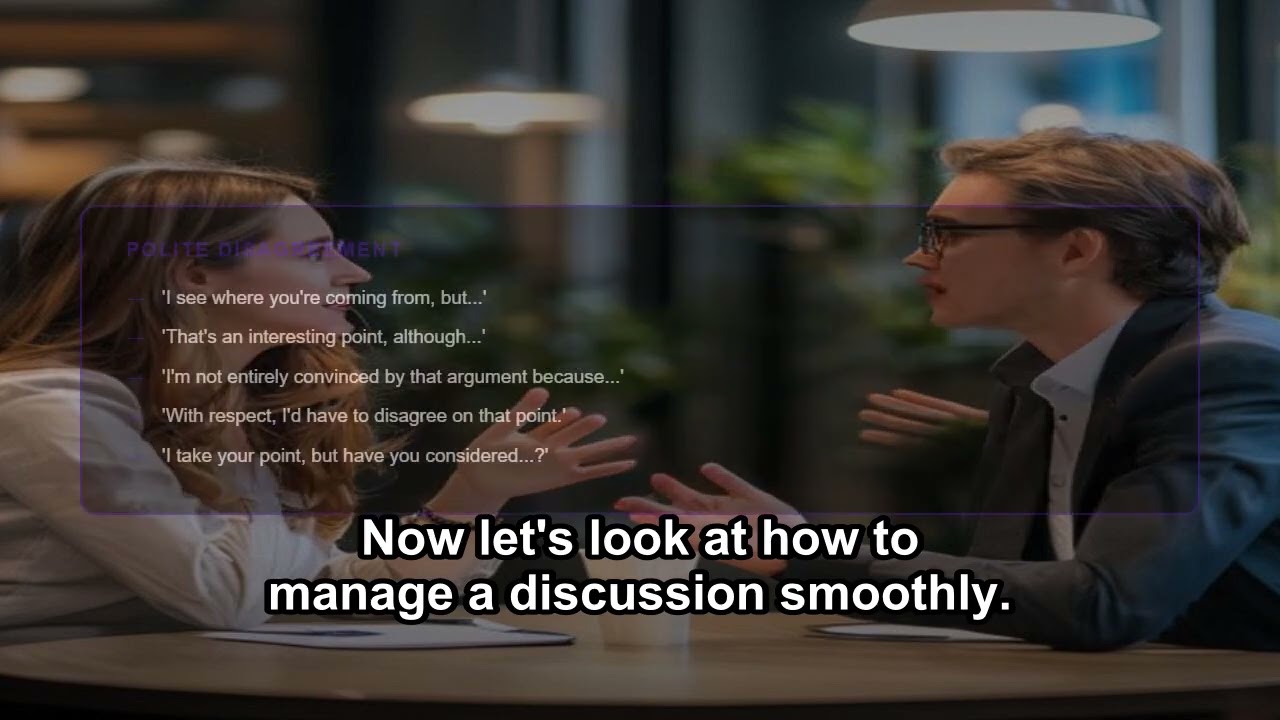
Phrase number 13, when you understand their side but still differ, it's a great way to start your counter argument politely.
La frase número 13, cuando entiendes su punto de vista pero aún difieres, es una excelente manera de comenzar tu contraargumento de forma educada.
I see where you're coming from, but...
Entiendo de dónde vienes, pero...
Example, I understand your point about needing more budget, but we really need to cut costs right now.
Por ejemplo, entiendo tu punto sobre necesitar más presupuesto, pero realmente necesitamos reducir costos ahora mismo.
A right-coming way to introduce a different view, phrase number 14.
Una forma adecuada de introducir una visión diferente, la frase número 14.
On the other hand, this signals you're about to present a contrasting idea, often to show a balanced perspective.
Por otro lado, esto indica que estás a punto de presentar una idea contrastante, a menudo para mostrar una perspectiva equilibrada.
Example, the new rules are stricter, but on the other hand, they might improve safety.
Por ejemplo, las nuevas reglas son más estrictas, pero por otro lado, podrían mejorar la seguridad.
And finally, for this section, phrase number 15, for when you simply have a different opinion.
Y finalmente, para esta sección, la frase número 15, para cuando simplemente tienes una opinión diferente.
It's direct, but still quite polite and clear.
Es directa, pero sigue siendo bastante educada y clara.
I don't really agree.
En realidad no estoy de acuerdo.
Example, I think pineapple belongs on pizza.
Por ejemplo, creo que la piña pertenece en la pizza.
I don't really agree.
En realidad no estoy de acuerdo.
I prefer it without pineapple.
Prefiero sin piña.
These are excellent for maintaining harmony in the conversation.
Estas son excelentes para mantener la armonía en la conversación.
But what if you disagree more strongly or you want to challenge an idea directly?
¿Y qué pasa si estás en desacuerdo de manera más firme o quieres cuestionar una idea directamente?
Part four, strong disagreement and challenging ideas.
Parte cuatro: desacuerdo fuerte y cuestionamiento de ideas.
All right, Jack, sometimes you need to express stronger disagreement or challenge an idea.
Muy bien, Jack, a veces necesitas expresar un desacuerdo más firme o cuestionar una idea.
What's our 16th phrase?
¿Cuál es nuestra decimosexta frase?
For phrase number 16, when you simply don't think something is correct, often used to correct a factual error or a strong opinion you believe is wrong, that's not right.
Para la frase número 16, cuando simplemente no crees que algo sea correcto, a menudo se usa para corregir un error factual o una opinión fuerte que consideras equivocada: eso no es así.
It's direct and clear.
Es directa y clara.
Or if you think an idea or statement is completely wrong and you want to be very firm, I totally disagree.
O si piensas que una idea o declaración es completamente incorrecta y quieres ser muy firme: estoy totalmente en desacuerdo.
This is a strong, firm statement.
Esta es una afirmación fuerte y firme.
Example, learning English is impossible without living abroad.
Ejemplo: aprender inglés es imposible sin vivir en el extranjero.
I totally disagree.
Estoy totalmente en desacuerdo.
You can learn a lot from home with the right methods.
Puedes aprender mucho desde casa con los métodos adecuados.
Phrase number 18, when you want to directly counter a point, often used in more formal discussions or debates, I beg to differ.
Frase número 18, cuando quieres contrarrestar directamente un punto, a menudo usada en discusiones o debates más formales: me permito discrepar.
This is a more formal but still common way to say I disagree.
Esta es una forma más formal pero aún común de decir que no estás de acuerdo.
Example, our data shows that sales are increasing.
Ejemplo: nuestros datos muestran que las ventas están aumentando.
Well, I beg to differ.
Bueno, me permito discrepar.
My report shows a slight decline.
Mi informe muestra un ligero descenso.
For phrase number 19, when you find an idea unbelievable or completely wrong, often used informally with a strong emotional reaction.
Para la frase número 19, cuando encuentras una idea increíble o completamente errónea, a menudo se usa informalmente con una reacción emocional fuerte.
No way.
¡De ninguna manera!
This is very casual and often used in strong emotional disagreement.
Esto es muy coloquial y a menudo se usa en desacuerdos emocionales fuertes.
Example, they're canceling our favorite show.
Ejemplo: están cancelando nuestro programa favorito.
No way.
¡De ninguna manera!
That's terrible news.
Es una noticia terrible.
Phrase number 20, when you think an argument has a flaw, allowing you to acknowledge their point before showing its weakness or missing piece.
Frase número 20, cuando piensas que un argumento tiene un defecto, lo que te permite reconocer su punto antes de mostrar su debilidad o pieza faltante.
That's a good point, but it doesn't take into account.
Es un buen punto, pero no tiene en cuenta...
Example, your plan saves money, but it doesn't take into account the extra time we'll need.
Ejemplo: tu plan ahorra dinero, pero no tiene en cuenta el tiempo extra que necesitaremos.
With these 20 phrases, you're now equipped to handle almost any conversation, whether you agree or not, and sound natural doing it.
Con estas 20 frases, ahora estás equipado para manejar casi cualquier conversación, ya estés de acuerdo o no, y sonar natural haciéndolo.
Wow, Nina, we've covered a wide range of phrases for agreeing and disagreeing today.
Vaya, Nina, hemos cubierto una amplia gama de frases para estar de acuerdo y en desacuerdo hoy.
This is going to make our listeners' English conversations so much more rich and authentic.
Esto hará que las conversaciones en inglés de nuestros oyentes sean mucho más ricas y auténticas.
Absolutely.
Absolutamente.
Let's quickly recap all of these key phrases.
Repasemos rápidamente todas estas frases clave.
Listen and try to say them after us and think about how you can use them in your next English discussion.
Escucha e intenta repetirlas después de nosotros y piensa en cómo puedes usarlas en tu próxima discusión en inglés.
Phrases number one.
Frase número uno.
Exactly.
Exacto.
Two.
Dos.
I couldn't agree more.
No podría estar más de acuerdo.
Three.
Tres.
Tell me about it.
Cuéntame sobre ello.
Four.
Cuatro.
I know, right?
Lo sé, ¿verdad?
Five.
Cinco.
You can say that again.
Puedes decirlo otra vez.
6.
6.
I agree with you.
Estoy de acuerdo contigo.
7.
7.
I see your point.
Entiendo tu punto.
8.
8.
That's a good point.
Es un buen punto.
9.
9.
I think so, too.
Yo también lo pienso así.
10.
10.
I suppose so.
Supongo que sí.
11.
11.
I'm not sure about that.
No estoy seguro de eso.
12.
12.
I don't think so.
No creo que sea así.
13.
13.
I see where you're coming from, but...
Entiendo de dónde vienes, pero...
14.
14.
14.
14.
On the other hand.
Por otro lado.
Fifteen.
Quince.
I don't really agree.
Realmente no estoy de acuerdo.
Sixteen.
Dieciséis.
That's not right.
Eso no es correcto.
Seventeen.
Diecisiete.
I totally disagree.
Totalmente en desacuerdo.
Eighteen.
Dieciocho.
I beg to differ.
Permíteme disentir.
Nineteen.
Diecinueve.
No way.
De ninguna manera.
Twenty.
Veinte.
That's a good point, but it doesn't take into account...
Es un buen punto, pero no tiene en cuenta...
Great job, everybody.
Buen trabajo, a todos.
Remember, listen to these phrases, try to imitate our pronunciation, and then actively try to use them in your own English practice.
Recuerda escuchar estas frases, intenta imitar nuestra pronunciación y luego trata de usarlas activamente en tu propia práctica de inglés.
All right, let's wrap this up.
Bien, terminemos aquí.
Today you learned 20 essential English phrases to competently agree and disagree, from polite nuances to strong statements.
Hoy aprendiste 20 frases esenciales en inglés para estar seguro al estar de acuerdo o en desacuerdo, desde matices corteses hasta afirmaciones firmes.
These phrases will help you sound much more natural and expressive in any conversation.
Estas frases te ayudarán a sonar mucho más natural y expresivo en cualquier conversación.
Now we're curious.
Ahora tenemos curiosidad.
Which of these phrases, for agreeing or disagreeing, do you find most useful?
¿Cuál de estas frases para estar de acuerdo o en desacuerdo encuentras más útil?
or which one will you try to use in your next English conversation?
o ¿cuál intentarás usar en tu próxima conversación en inglés?
Drop your answers in the comments below.
Deja tus respuestas en los comentarios a continuación.
We love hearing from you.
Nos encanta saber de ti.
If this episode helped you feel more confident about expressing your opinions in English, please smash that like button wherever you're listening, subscribe to The English Habit for more amazing content, and ring that notification bell.
Si este episodio te ayudó a sentirte más seguro al expresar tus opiniones en inglés, por favor dale 'me gusta' donde sea que estés escuchando, suscríbete a The English Habit para más contenido increíble y activa la campana de notificaciones.
Thanks for listening, and remember, don't be afraid to voice your opinions in English.
Gracias por escuchar, y recuerda, no tengas miedo de expresar tus opiniones en inglés.
See you in the next one.
Nos vemos en el próximo episodio.
Bye.
Adiós.