Browse and practise high-value quotes from this video
“Yes, and one of the most common questions in English is, Excuse me, could you tell me how to get to...”
Yes, and one of the most common questions in English is, Excuse me, could you tell me how to get to...
Why it is worth remembering
Teaches the standard polite formula for requesting navigation help, which is universally applicable in English-speaking contexts.
Reusable video chunk
Yes and one of the most common questions in English ... Excuse me could you tell me how to get to
Handpicked content based on the current video topic and level
This lesson addresses the anxiety of asking for directions in English while traveling. It provides natural, polite phrases to initiate requests, such as 'Excuse me, could you tell me how to get to...?' and explains that native speakers often use time-based estimates ('It's a 10-minute walk') rather than precise distances. The video highlights key directional phrasal verbs like 'head down' and idiomatic uses of 'hit' (meaning to reach). It also teaches strategies for clarification, including asking for repetition or repeating instructions back, and offers techniques to handle mental blocks by pausing confidently or using visual aids like phone maps.
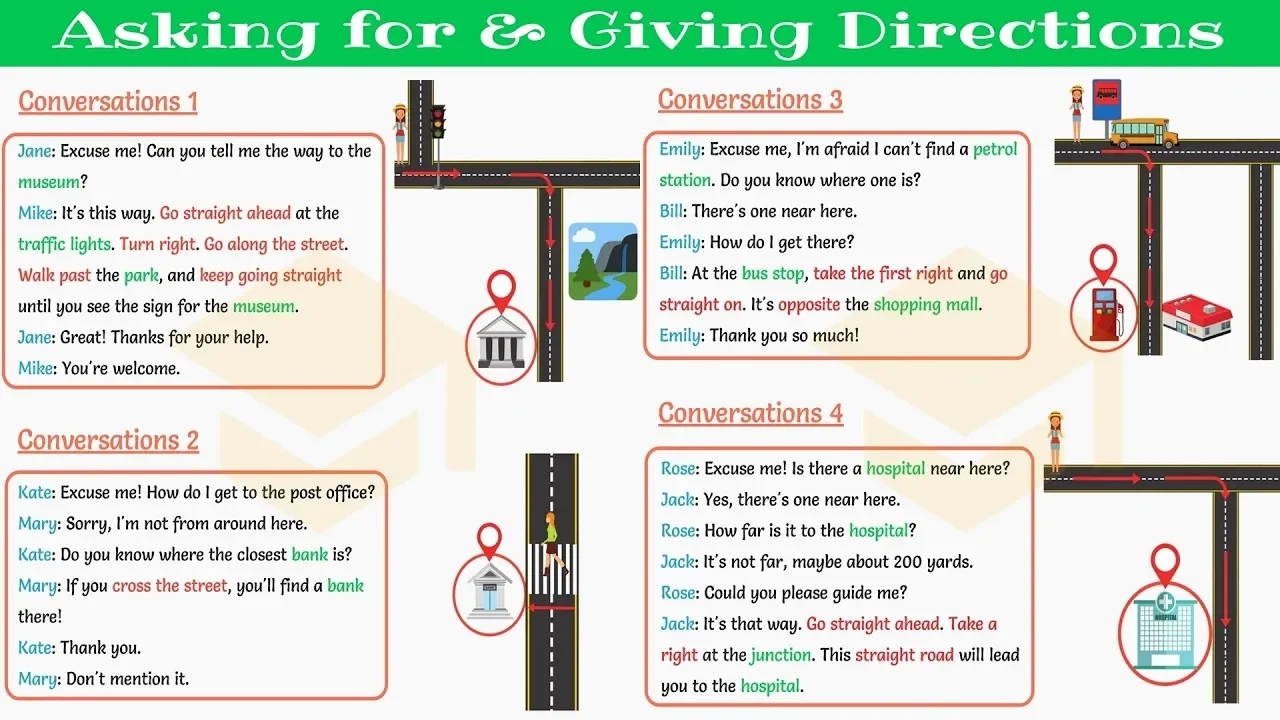
This video provides practical English expressions for asking for and giving directions in daily conversations. It features five distinct scenarios: finding a museum, locating a post office or bank, finding a petrol station, navigating to a hospital, and reaching Brington Resort and an art gallery. The dialogue demonstrates polite inquiry phrases such as 'Excuse me, can you tell me the way to...?' and 'Do you know where... is?'. It also covers essential directional commands like 'Go straight ahead', 'Turn right/left', and 'Walk past...', along with landmark references like 'opposite the shopping mall' or 'between a pharmacy and a skyscraper'. Additionally, it includes useful responses for those who cannot help ('Sorry, I'm not from around here') and warnings about road conditions.
This lesson teaches English learners how to ask for and give directions in real-life situations. It covers polite ways to approach strangers, essential phrases for inquiring about locations, and vocabulary for understanding street types and prepositional phrases. The video includes guided shadowing practice and dialogue examples to help learners build confidence in navigation conversations.